Showing posts with label Abbot Anscar Vonier. Show all posts

Friday, February 3, 2012

Abbot Vonier on "Participation" in the Eucharistic Sacrifice


In the "Constitution on the Sacred Liturgy" (#14), the Vatican Council II fathers famously declared "that all the faithful should be led to that full, conscious and active participation in liturgical celebrations which is demanded by the very nature of the liturgy, and to which the Christian people, 'a chosen race, a royal priesthood, a holy nation, a redeemed people' (1 Pt. 2:9, 4-5) have a right and obligation by reason of their baptism."   Debate over the meaning of "active participation" has been going on ever since.  To many, active participation requires moving about, clapping, or, at the very least, holding hands.  Others take participation in a very different sense.  Although he was writing many decades before the Council, Abbot Vonier addressed participation in the Eucharist by the faithful in his masterful text "A Key to the Doctrine of the Eucharist:"

"If the sacramental character of the priest enables him to be the sacrificant in Christ's Person, sacramental character also enables the multitude of the faithful to join in that sacrifice in their own way.  The sacramental character of Baptism first, and then the sacramental character of Confirmation, are with the sacramental character of Order, though in a lesser degree, figures and resemblances of Christ's Priesthood; and therefore every baptized person is radically fit to communicate in that great sacrifice, to be a sacrificant - at least by participation.

"The sacramental character is a certain participation of the priesthood of Christ in His faithful, in the sense that as Christ has the full power of spiritual priesthood, His faithful also are made like Him in this, that they share in a certain spiritual power with regard to the sacraments and to those things which belong to the divine cult." (St. Thomas Aquinas, Summa Theologica, III, q, 63, a. 5)

Friday, January 20, 2012

Transubstantiation (Part 2)

Cardinal Stritch elevates chalice


According to the Catholic Catechism, the Eucharist is the source and summit of the Christian life - a sacrament of inexhaustible richness.  Though the Eucharist is a mystery, and therefore something we can never fully understand, the Church teaches very clearly regarding the Eucharist, and we must strive to grasp this teaching as thoroughly as possible.  Earlier this month I quoted from Abbot Vonier's magnificent text "A Key to the Doctrine of the Eucharist."   The following is again taken from Abbot Vonier:

"Here are Saint Thomas [Aquinas]'s own words:

The Body of Christ is not in this sacrament in the manner in which a body is in a place, having its dimensions commensurate with that place; but it is present in a certain special manner, which belongs exclusively to this sacrament.  So we say that the Body of Christ is on many altars, not as in so many places, but as in the sacrament; by which we do not mean that Christ is there only in a sign, although the sacrament be of the genus sign; but we understand that His Body is there according to the manner proper to the sacrament."

St. Thomas Aquinas, most excellent teacher concerning the Eucharist, pray for us.

Thursday, January 12, 2012

Transubstantiation


According to the Catholic Catechism, the Eucharist is the source and summit of the Christian life - a sacrament of inexhaustible richness.  Though the Eucharist is a mystery, and therefore something we can never fully understand, the Church teaches very fully and clearly regarding the Eucharist, and we must strive to grasp this teaching as thoroughy as possible.  A very good source for this teaching is Abbot Vonier's magnificent text "A Key to the Doctrine of the Eucharist."  The following is taken from the chapter "Transubstantiation:"

"Wherever a priest, in the name of Christ, pronounces the sacramental consecration, the substance of the bread and the substance of the wine are changed into the substance of Christ's Body and the substance of Christ's Blood.  There is no bringing down from heaven of the Body and Blood of Christ; this is not the Eucharist; but Christ's Body and Christ's Blood are truly produced in an act of divine power, as grace is produced in the human soul at Baptism."

St. Thomas Aquinas, masterful teacher regarding the Eucharist, pray for us.

Tuesday, November 8, 2011

"Eucharistic Representation, Application, and Immolation"


We continue our review of Abbot Vonier's highly instructive text "A Key to the Doctrine of the Eucharist."  Abbot Vonier follows St. Thomas Aquinas closely in describing what takes place sacramentally on the altar at Mass.

"As the Body and Blood on the altar are such a perfect representation of the broken Son of God on Calvary, they are also the most immediate and complete contact of the soul with all the saving power of Golgotha. . . . It would not be enough, in order to explain the total range of the Eucharistic sacrifice, to say that at the altar we offer up the Body and Blood of Christ; we do more, we immolate Christ, but - and here is an immense difference - not the Christ who is in heaven, because as such He is not represented on the altar at all, but the Christ of Calvary, as the Christ of Calvary is the only one who is represented on the altar."

St. Thomas Aquinas, pray for us.


Tuesday, October 25, 2011

"The Sacrament-Sacrifice of the Mass: Its Positive Aspect"


I may seem to have developed a fixation with books about the Eucharist.  For this I don't apologize, since Mass is the central worship of the Church, and thus for Catholics no topic can be more important.  Further, it seems to me that in recent years certain fundamental realities of Mass have become obscured.  In particular, the reality of Eucharist as sacrifice and as sacrament, as well as the Real Presence of Christ in the Eucharist have, to a shocking extent in some places, lost their importance to Catholics.  Indeed, it is a fair surmise that Catholics have lost their faith in these things.  Certainly, the behavior of many Catholics at Mass and in the presence of the Eucharist warrants the conclusion that they do not believe themselves to be in the presence of the body and blood, soul and divinity of Jesus Christ. 

In this atmosphere of inattention, to remind myself and others of the infinite importance of the Eucharist seems an urgent duty.   Which leads me to yet another long, but highly instructive, quotation from Abbot Vonier's  text, "A Key to the Doctrine of the Eucharist:"

"In the [Eucharist] the Church must act the spiritual thing with such clearness, power and directness, that no one will question her meaning; she really means to accomplish what she acts, as it were, on the stage of sacramental symbolism.  The inward reality of the sacrament is the prolongation of the signification of the sacrament.  Having gone thus far in saying and doing sacramental things we cannot stop short of the real thing.  We all know of the blasphemous gibes of the more ignoble sort of Protestant who uses the hideous word "incantation" to describe the sacramental rites of Catholicism.  An incantation is an expression of words and symbols so strong that the very spirits are tied to them.  I, for one, shall not blush for the accusation if, in my priestly office, I am supposed to use words and things so expressive that they must have the divine thing irrevocably tied to them.  I am not making arbitrary signs and pronouncing words of mere convention when I officiate at the altar and consecrate the bread and wine.  I am performing a rite which, if seen in its whole setting, must mean the Body and Blood of Christ as a sweet odor of sacrifice."

St. Thomas Aquinas, pray for us.

Friday, October 21, 2011

"The Sacrament-Sacrifice of the Mass: Its Negative Aspect" (part 2)


We continue our review of Abbot Vonier's highly instructive text "A Key to the Doctrine of the Eucharist."  Abbot Vonier discusses the relation between Christ's passion and death and the Eucharist:

"Christ's natural sacrifice and Christ's Eucharistic sacrifice stand to each other in a relationship which is truly unique in the whole realm of revealed truth; one represents the other, but one does not complete the other.  The oneness of Christ's redemptive sacrifice is a matter of Catholic dogma; but this oneness is preserved only if we make the distinction, with Saint Thomas, that on Calvary Christ was offered up in propria specie, and that on the altar He is offered up in specie sacramenti.  True oneness is in fact saved only through the total diversity of the two states."

St. Thomas Aquinas, pray for us.


Wednesday, October 19, 2011

"The Sacrament-Sacrifice of the Mass: Its Negative Aspect"


We continue our exploration of Abbot Vonier's highly instructive text, "A Key to the Doctrine of the Eucharist:"

"The Catholic has never found it difficult to see the fitness of Christ's concluding words when He announced the mystery of His Flesh and Blood to be eaten and drunk by man: "The words that I have spoken to you are spirit and life."  We find in this utterance the very thing that is dear to us: the profound difference between the natural order and the sacramental order.  It is the cherished aim of Christian writers to extol the spiritual, the immaterial,character of the Eucharistic sacrament; and all through Christian literature there flows this double current, the one of faith in the reality of the divine Thing that is contained in the sacrament, and the other of delight in its absolute other-worldliness.  The sacramental sphere is an unknown world with a well-known inhabitant."

St. Thomas Aquinas, pray for us.


Friday, October 14, 2011

"The Sacramental Idiom of Saint Thomas" (part 2)

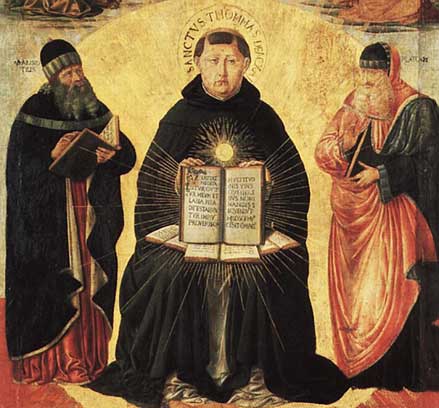
                                                       "Triumph of St. Thomas Aquinas" by Benozzo Gozzoli

We continue our review of Abbot Vonier's highly instructive text, "A Key to the Doctrine of the Eucharist."


Abbot Vonier again quotes St. Thomas of Aquinas, this time from the Office for the Feast of Corpus Christi, which St. Thomas composed:

"O God, who in this wonderful sacrament has bequeathed to us a memory of your Passion, grant us, we beseech Thee, so to venerate the sacred mysteries of your Body and Blood that we will continually experience the fruit of your Redemption in us."

St. Thomas of Aquinas, pray for us.


Monday, October 10, 2011

"The Sacramental Idiom of Saint Thomas"


We continue our review of Abbot Vonier's "A Key to the Doctrine of the Eucharist."  Abbot Vonier again quotes St. Thomas:

The Paschal Lamb, ... prefigures this sacrament in a threefold manner; Firstly, inasmuch as it was eaten with unleavened bread, according to Exodus 12:8, They shall eat the flesh . . . and unleavened bread.  Secondly, it was immolated by the entire multitude of the children of God on the fourteenth day of the month, a figure of the passion of Christ who on account of His innocence was called the Lamb.  But with regard to the effect, as by the blood of the Paschal Lamb the children of Israel were protected by the destroying angel, and delivered from the Egyptian captivity, so the Paschal Lamb is the chief figure of this sacrament, for in all like things it foreshadows it.

St. Thomas Aquinas, pray for us.

Friday, October 7, 2011

"Sacramental Harmony"

                                 High Altar, St. Francis de Sales Oratory, St. Louis, Missouri


We continue our review of Abbot Vonier's "A Key to the Doctrine of the Eucharist."  Abbot Vonier here quotes St. Thomas:

A sacrament is so called because it contains something sacred.  Now a thing may be sacred in two ways, either absolutely, or with reference to something else.  The difference between the Eucharist and the other sacraments which have a matter known to the senses is this, that the Eucharist contains something sacred absolutely, namely Christ Himself; but the water of Baptism contains something sacred with regard to something else, that is to say, it contains the power of sanctifying; and the same thing may be said of the chrism and of the other sacramental things.  Consequently, the sacrament of the Eucharist is fully accomplished (perficitur) in the very consecration of the matter, while the other sacraments are fully accomplished in the application of the matter to the man to be sanctified. 

From this another difference follow; for in the sacrament of the Eucharist what is the "thing and the sacrament" (res et sacramentum) is in the matter itself; while what is the "thing only (res tantuni) - i.e., the grace which is given - is in the one who receives the Eucharist; but in Baptism both are in the recipient, that is to say, character, which is the "thing and the sacrament" and the grace of remission of sins, which is the "thing" only, and the same may be said of the other sacraments.


St. Thomas of Aquinas, pray for us.

Wednesday, October 5, 2011

"The Sacramental Role"

                                             "Via Dolorosa,"   Magdalene College Chapel,    Cambridge


We continue our review of Abbot Vonier's "A Key to the Doctrine of the Eucharist."   This is taken from Chapter 6, "The Sacramental Role:"

The sacramental graces are specially characterized by their intimate connection with Christ's passion and death.  They are not just any grace, but grace as flowing from the pierced side of Christ.  "Why is it," asks Saint Thomas, "that Baptism washes away, even in the old sinner who approaches it, every stain of sin and all the guilt of sin besides?"  "The suffering of the passion of Christ is communicated to the one who is baptized, inasmuch as he becomes a member of Christ, as if he himself had borne that pain, and therefore all his sins are remitted through the pain of Christ's passion."

Monday, October 3, 2011

"Sacramental Thought"


We continue our review of Abbot Vonier's "A Key to the Doctrine of the Eucharist."   This is taken from Chapter 5, "Sacramental Thought:"

The stream of sacramental grace is truly the flow of the Blood of Christ: in one way or another every sacrament is the fire of Christ's love when He was dying on the Cross.

Perhaps the most satisfying line of sacramental thought is to visualize the sacraments as mysterious carriers of all the powers that are in Christ's death.  "The power of Christ's passion," say Saint Thomas, "is joined to us (copulatur nobis) through faith and through the sacraments, yet in different ways; for the contact (continuatio) which is through faith takes place through the act of the soul, but the contact which is through the sacraments takes place though the use of external things."

St. Thomas Aquinas, pray for us.

Monday, September 26, 2011

"The Perfection of Sacramental Signification"


The following is taken from Abbot Vonier's "A Key to the Doctrine of the Eucharist:"

Saint Thomas [Aquinas] has thought it worth his while to devote an Article to this very subject:  Whether the Body of Christ as It is in this sacrament can be seen by any eye, at least one glorified?"
"The Body of Christ," he answers,

according to the mode of being which it has in this sacrament, cannot be detected, either by the senses or by  imagination, but only through the intellect, which is called the spiritual eye.  It is, however, detected by various intellects in various degrees.   As the mode of being according to which Christ is in this sacrament is entirely supernatural, Christ is visible to the supernatural intellect only, I mean, the divine intellect; and, as a consequence, to the beatified intellect, either of angel or man, which in a participated brightness of the divine intellect sees the supernatural thing, in the vision of the divine essence; but as for the intellect of man here on earth, it cannot perceive [the sacramental Presence of Christ] otherwise than by faith, as is the case with all other supernatural things; nor is the angelic intellect capable of seeing it, left to its merely natural resources.

St. Thomas of Aquinas, pray for us.

Wednesday, September 21, 2011

"The Power of Sacramental Signification"


The following is taken from Abbot Vonier's "A Key to the Doctrine of the Eucharist."  Abbot Vonier is again quoting St. Thomas Aquinas:

"My answer is, that, as has been already said, the sacrament, properly so-called, is a thing ordained to signify our sanctification; in which three phases may be taken into consideration, namely: the cause of our sanctification, which is the passion of Christ; the essence of our sanctification, which consists in grace and virtue; and then the ultimate goal of our sanctification, which is eternal life.  Now all these are signified by the sacraments.  Therefore a sacrament is a commemorative sign of what has gone before, in this case the passion of Christ, a demonstrative sign of what is being effected in us through the passion of Christ, that is grace, and a prognostic sign, foretelling our future glory."


St. Thomas Aquinas, pray for us.

Tuesday, September 20, 2011

On God's action in the soul, or Grace


                                         "St. Thomas Aquinas," by Benozzo Gozzoli

From Chapter One of Abbot Vonier's "A Key to the Doctrine of the Eucharist:"


I cannot end this chapter without quoting from Saint Thomas [of Aquinas] a beautiful passage in which he describes God's action, which he calls grace, keeping faith alive in the soul, even of the sinner:

Grace produces faith not only when faith begins to exist in the soul for the first time, but also while it habitually abides in the soul . . . . God brings about the justification of man in the same way as the sun produces light in the air.  Grace, therefore, when it strikes with its rays the one who is already a believer is not less efficacious than when it comes for the first time to the unbeliever, because in both it is its proper effect to produce faith: in one case strengthening it and giving it increase, in the other case creating it as an entirely new thing.

St. Thomas of Aquinas, pray for us.

Tuesday, September 13, 2011

Who was Anscar Vonier?


Abbot Vonier "was the most gifted dogmatic theologian writing - and preaching - in England in the inter-war years."  He is also the author of "A Key to the Doctrine of the Eucharist," a book which Avery Cardinal Dulles, SJ said "should never be out of print."  I just ordered my copy.  You can order yours by clicking on the "My Favorites" widget to the right.  That way (assuming I set it up correctly) Amazon will share a tiny fraction of the proceeds with me, at no additional cost to you.
 
Incidentally, many years ago I had the good fortune to be introduced to Avery Dulles.  Fr. Dulles was at lunch in a Jesuit residence, and surrounded by admirers.  He appeared to suffer rather than welcome this attention.  Fr. Dulles was tall and thin and wore a white dress shirt which had been ironed sufficiently to remove most, though by no means all, of its wrinkles.  I suspect the ironing had been done by Fr. Dulles himself.   He was courteous, though not effusive.   Though our meeting was over in minutes, I knew afterwards that Fr. Dulles didn't attract crowds to himself just because he was famous.  Fr. Dulles, in his quiet, courteous way, was also a holy man.