"They" are The Community of Jesus, a co-ed community of mostly protestant artists living according to the Rule of St. Benedict on Cape Cod. Sandro Magister has more.
Thoughts on topics of interest mainly to Catholics, including sacraments, the Virgin Mary, saints, angels, popes, feast days, liturgy, liturgical music, prayer, Church Fathers, Doctors of the Church, rosaries, religious congregations, novenas, Catholic education, and the Sacred Heart.
Friday, October 7, 2011
Well, they sure have a pretty church
"They" are The Community of Jesus, a co-ed community of mostly protestant artists living according to the Rule of St. Benedict on Cape Cod. Sandro Magister has more.
Labels:
Sandro Magister,
The Rule of St. Benedict
Hail, Our Lady of the Rosary
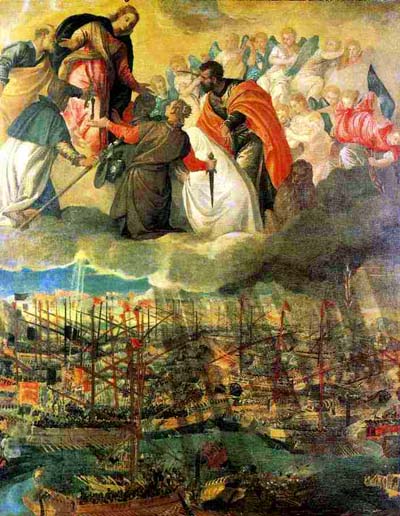
"Allegory of the Battle of Lepanto" by Veronese
Today we celebrate the Feast of Our Lady of the Rosary. The feast commemorates a decisive victory won, on Sunday October 7, 1571, by the combined fleets of Venice, Spain, Genoa and other Catholic maritime states over a much larger force of Turks in the Straits of Lepanto off western Greece. The victory prevented the Ottoman Turks, seemingly unstoppable hitherto, from expanding further westward in the Mediterranean, thereby lifting the threat of Turkish invasion from Rome, and from all of Italy.
The Holy League and Pope St. Pius V credited the victory to the intercession of the Virgin Mary, and with good reason. Each vessel in the fleet had prayed the Rosary daily on the voyage from Sicily to battle. Their admiral, Andrea Doria, kept a copy of the image of Our Lady of Guadalupe given him by King Philip II of Spain in his stateroom. The Spanish commander, Don Juan of Austria, flew the standard of Our Lady of Guadalupe from his masthead. Perhaps most importantly of all, Pope St. Pius V had ordered all monasteries and convents in Rome to pray for the success of the Holy League's fleet, and himself organized Rosary processions throughout the city.
Pope St. Pius V ordered a day of thanksgiving in honor of Our Lady of Victory to be kept every October 7. In 1573, Pope Gregory XIII changed the title of the feast to Our Lady of the Rosary, and transferred the celebration to the first Sunday in October. In 1716, Pope Clement XII extended the feast to the entire Latin Church. In 1913, Pope St. Pius X transferred the date of the feast to its original date of October 7.
Today we celebrate the Feast of Our Lady of the Rosary. The feast commemorates a decisive victory won, on Sunday October 7, 1571, by the combined fleets of Venice, Spain, Genoa and other Catholic maritime states over a much larger force of Turks in the Straits of Lepanto off western Greece. The victory prevented the Ottoman Turks, seemingly unstoppable hitherto, from expanding further westward in the Mediterranean, thereby lifting the threat of Turkish invasion from Rome, and from all of Italy.
The Holy League and Pope St. Pius V credited the victory to the intercession of the Virgin Mary, and with good reason. Each vessel in the fleet had prayed the Rosary daily on the voyage from Sicily to battle. Their admiral, Andrea Doria, kept a copy of the image of Our Lady of Guadalupe given him by King Philip II of Spain in his stateroom. The Spanish commander, Don Juan of Austria, flew the standard of Our Lady of Guadalupe from his masthead. Perhaps most importantly of all, Pope St. Pius V had ordered all monasteries and convents in Rome to pray for the success of the Holy League's fleet, and himself organized Rosary processions throughout the city.
Pope St. Pius V ordered a day of thanksgiving in honor of Our Lady of Victory to be kept every October 7. In 1573, Pope Gregory XIII changed the title of the feast to Our Lady of the Rosary, and transferred the celebration to the first Sunday in October. In 1716, Pope Clement XII extended the feast to the entire Latin Church. In 1913, Pope St. Pius X transferred the date of the feast to its original date of October 7.
Until 1968, a plenary indulgence called "the Portiuncula of the Rosary" was granted to all who visited a Rosary chapel or statue of Our Lady on this feast. The new Enchiridion (Handbook) of Indulgences still permits a plenary indulgence to be obtained, but in a different way. Under the usual conditions, (sacramental Confession and Communion within a week, before or after; reception of Holy Communion; prayer for the intentions of the pope; and absence of "all attachment to sin, even venial sin.") "A plenary indulgence is granted, if the Rosary is recited in a church or public oratory or in a family group, a religious Community, or pious Association; a partial indulgence is granted in other circumstances."
Our Lady of the Rosary, pray for us.
UPDATE: The Catholic navies had better technology, and this was no accident.
Thursday, October 6, 2011
Wisdom from St. Therese of Lisieux
"St. Therese of Lisieux" by Inigo Hicks
On Oct. 4 we celebrated the feast of St. Therese of Lisieux. The following is taken from St. Therese's journal, published under the title "The Story of a Soul :"
Love alone attracts me. I no longer wish for either suffering or death and yet both are precious to me. For a long time I've hailed them as messengers of joy. I've already known suffering and I've thought I was approaching the eternal shore. From my earliest days I have believed that the Little Flower would be plucked in the springtime of her life. But today my only guide is self-abandonment. I have no other compass. I no longer know how to ask passionately for anything except that the will of God shall be perfectly accomplished in my soul. I can repeat these words of our Father, St. John of the Cross: "I drank deep within the hidden cellar of my Beloved and, when I came forth again, I remembered nothing of the flock I used to look after. My soul is content to serve Him with all its strength. I've finished all other work except that of love. In that is all my delight."
Or rather: "Love has so worked within me that it has transformed my soul into itself."
St. Therese of Lisieux, pray for us.
On Oct. 4 we celebrated the feast of St. Therese of Lisieux. The following is taken from St. Therese's journal, published under the title "The Story of a Soul :"
Love alone attracts me. I no longer wish for either suffering or death and yet both are precious to me. For a long time I've hailed them as messengers of joy. I've already known suffering and I've thought I was approaching the eternal shore. From my earliest days I have believed that the Little Flower would be plucked in the springtime of her life. But today my only guide is self-abandonment. I have no other compass. I no longer know how to ask passionately for anything except that the will of God shall be perfectly accomplished in my soul. I can repeat these words of our Father, St. John of the Cross: "I drank deep within the hidden cellar of my Beloved and, when I came forth again, I remembered nothing of the flock I used to look after. My soul is content to serve Him with all its strength. I've finished all other work except that of love. In that is all my delight."
Or rather: "Love has so worked within me that it has transformed my soul into itself."
St. Therese of Lisieux, pray for us.
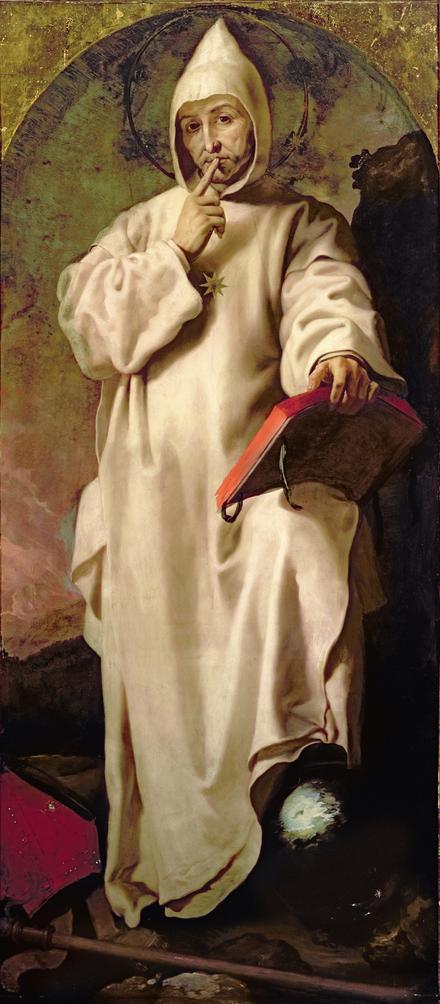
Hail, Saintly Monk and Founder of the Carthusians
"St. Bruno," by Francisco Ribalta
Today we celebrate the feast of St. Bruno (1030 AD - 1101 AD). Born at Cologne, St. Bruno was a canon, teacher and chancellor of the diocese of Reims, where he dutifully obtained the ouster of the evil bishop Manasses de Gournai. St. Bruno was the obvious choice to replace de Gournai, but had already decided to leave Reims and enter monastic life. He presented himself first to St. Robert of Molesme, who with his companions would go on to found the Cistercian order. Deciding this was not his vocation, St. Bruno next visited St. Hugh of Chateauneuf, the bishop of Grenoble, who led St. Bruno and his small band to a wild, rocky spot in the Alps called Chartreuse. There they built a monastery, planning to live as hermits while worshipping as a community. Though not their intention, these efforts led to the establishment of a new religious order, to be called the Carthusians. At its height, the Carthusians could count more than 200 foundations. Today there are 24 Carthusian monasteries throughout the world.
From time to time, St. Bruno was summoned from his solitude at Chartreuse to advise Pope Urban II, a former pupil. During one of these interludes away from Chartreuse, St. Bruno narrowly escaped being appointed bishop in Calabria. St. Bruno remains a popular saint in this region of Italy.
In 2002, the monks of Chartreuse permitted a German filmmaker to live among them for 4 and a half months. The filmmaker used only natural light, and shot and recorded the film himself. The resulting documentary is called "Into Great Silence." It is as close as most of us will get to experiencing life in a Carthusian monastery. Here is the film's trailer:
St. Bruno, pray for us.
Today we celebrate the feast of St. Bruno (1030 AD - 1101 AD). Born at Cologne, St. Bruno was a canon, teacher and chancellor of the diocese of Reims, where he dutifully obtained the ouster of the evil bishop Manasses de Gournai. St. Bruno was the obvious choice to replace de Gournai, but had already decided to leave Reims and enter monastic life. He presented himself first to St. Robert of Molesme, who with his companions would go on to found the Cistercian order. Deciding this was not his vocation, St. Bruno next visited St. Hugh of Chateauneuf, the bishop of Grenoble, who led St. Bruno and his small band to a wild, rocky spot in the Alps called Chartreuse. There they built a monastery, planning to live as hermits while worshipping as a community. Though not their intention, these efforts led to the establishment of a new religious order, to be called the Carthusians. At its height, the Carthusians could count more than 200 foundations. Today there are 24 Carthusian monasteries throughout the world.
From time to time, St. Bruno was summoned from his solitude at Chartreuse to advise Pope Urban II, a former pupil. During one of these interludes away from Chartreuse, St. Bruno narrowly escaped being appointed bishop in Calabria. St. Bruno remains a popular saint in this region of Italy.
St. Bruno, pray for us.
Wednesday, October 5, 2011
The Seven Deadly Sins
"The Seven Deadly Sins" by Hieronymous Bosch
As Marcellino D'Ambrosio rightly notes, "in our sex-saturated, hyper-active culture" we tend to overlook the dangers of sloth.
"The Sacramental Role"
"Via Dolorosa," Magdalene College Chapel, Cambridge
We continue our review of Abbot Vonier's "A Key to the Doctrine of the Eucharist." This is taken from Chapter 6, "The Sacramental Role:"
The sacramental graces are specially characterized by their intimate connection with Christ's passion and death. They are not just any grace, but grace as flowing from the pierced side of Christ. "Why is it," asks Saint Thomas, "that Baptism washes away, even in the old sinner who approaches it, every stain of sin and all the guilt of sin besides?" "The suffering of the passion of Christ is communicated to the one who is baptized, inasmuch as he becomes a member of Christ, as if he himself had borne that pain, and therefore all his sins are remitted through the pain of Christ's passion."
We continue our review of Abbot Vonier's "A Key to the Doctrine of the Eucharist." This is taken from Chapter 6, "The Sacramental Role:"
The sacramental graces are specially characterized by their intimate connection with Christ's passion and death. They are not just any grace, but grace as flowing from the pierced side of Christ. "Why is it," asks Saint Thomas, "that Baptism washes away, even in the old sinner who approaches it, every stain of sin and all the guilt of sin besides?" "The suffering of the passion of Christ is communicated to the one who is baptized, inasmuch as he becomes a member of Christ, as if he himself had borne that pain, and therefore all his sins are remitted through the pain of Christ's passion."
Humility is not the signal virtue of our age
According to St. Thomas, "the virtue of humility consists in keeping oneself within one's own bounds, not reaching out to things above one, but submitting to one's superior" (Summa Contra Gent., bk. IV, ch. lv, tr. Rickaby). We are accustomed to seeing humility's opposite, pride, on display everywhere, while humility, partly by its nature, is hidden. Nor is the zeitgeist congenial to humility; when it can be found humility is generally derided. Still, there are humble people among us, and here is the story of such a person, who, upon finding she'd overstepped her bounds, submitted to her superior. In this case, the superior to whom she submitted was God. What makes the story even more remarkable is that the woman had been a vicar, but left that ministry to become a Catholic.
Labels:
humility,
St. Thomas Aquinas,
women vicars
Subscribe to:
Posts (Atom)