Showing posts with label Our Lady of Sorrows. Show all posts

Saturday, September 15, 2012

Our Lady of Sorrows

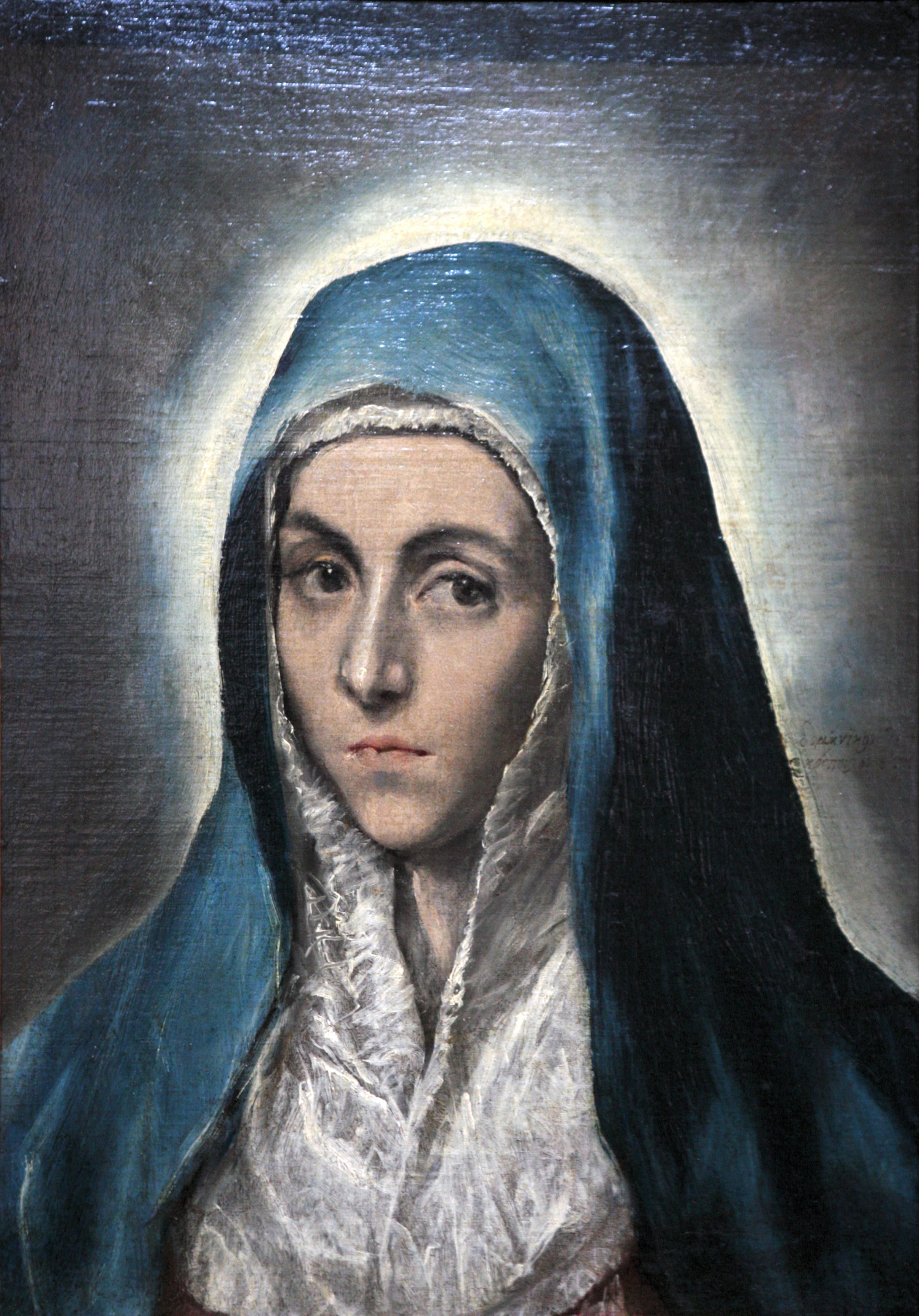
"Our Lady of Sorrows," El Greco

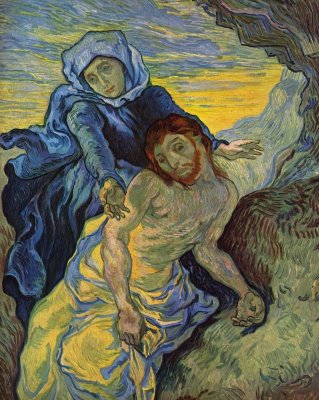
Today is the feast of Our Lady of Sorrows.   You may read a post with the full history of the feast (and a rarely seen Van Gogh Pieta) here.

The following comes from the Office of Readings for the feast, and is taken from a sermon by St. Bernard:

Perhaps someone will say: “Had she not known before that he would not die?” Undoubtedly. “Did she not expect him to rise again at once?” Surely. “And still she grieved over her crucified Son?” Intensely. Who are you and what is the source of your wisdom that you are more surprised at the compassion of Mary than at the passion of Mary’s Son? For if he could die in body, could she not die with him in spirit? He died in body through a love greater than anyone had known. She died in spirit through a love unlike any other since his.


Our Lady of Sorrows, pray for us.

Friday, September 23, 2011

The Seven Dolors of Our Lady in Art (Part 2)

September is the month the Church dedicates to contemplation of the Seven Dolors (or Sorrows) of Our Lady.
The second Dolor of Our Lady is the Flight into Egypt.  Over the centuries, many artists have depicted this episode.  Here is a sampling of the finer efforts:

                                                      Gislebertus, Cathedral at Autun, France

The tympanum of Autun Cathedral (ca. 1120 AD) is inscribed "Gislebertus hoc fecit" ("Gilbert made this").  It is not known whether Gislebertus was the patron who underwrote the tympanum, or the principal sculptor of the statues which decorate it.  If Gislebertus was indeed the sculptor, he was the first in medieval Europe to sign his work.  In any event, the Autun style of sculpture, with its expressive, graceful elongated figures, was very influential and imitated in many places.  The Autun statues also include an "Eve," the first large scale nude sculpture in Europe since Roman times. 
 

                                                             Chartres Cathedral (12th and 13th centuries)


In its long history, Chartres Cathedral has been spared major damage, though it has had several close calls.  For instance, during the French Revolution the Revolutionary Committee voted to blow up the Cathedral, but the architect in charge of the project argued that the rubble thereby created would take years to remove, and the plan was dropped.  However, the Cathedral did suffer the loss of its lead roof, which was removed to make bullets.   Before the outbreak of WWII, the Cathedral's stained glass was removed for safekeeping.  In 1944, the Cathedral itself was nearly destroyed by the US Army, which believed the structure had been occupied by elements of the German Army.  A two man reconnaissance team led by Col. Welborn Barton Griffin, Jr. revealed that the Cathedral was free of German troops, and the order to bombard the cathedral was rescinded.  In August, 1944, Col Griffin was killed in action.


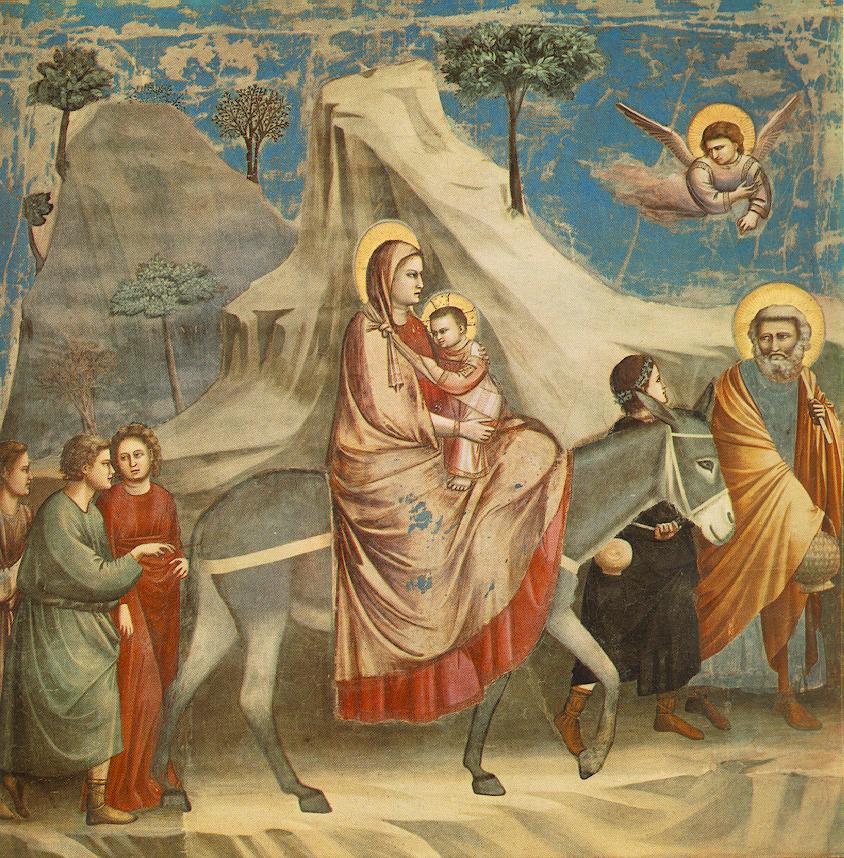
                                         Giotto, Scrovegni Chapel (also called the Arena Chapel), Padua

The Scrovegni family derived its fortune from usury, which the Church condemned.   Indeed, Dante placed Reginaldo degli Scrovegni in the seventh circle of Hell.  It is believed the Scrovegni family built the beautiful Arena Chapel, decorated with Giotto frescoes depicting scenes from the life Our Lord and consecrated in 1305 AD, as penance for these sins.

                                                       Fra Angelico

Fra Angelico (1395 AD - 1455 AD) , a Dominican friar, was beatified in 1982.

                                                        "Rest on the Flight to Egypt," by Murillo

Though the Rest on the Flight to Egypt is not mentioned in the Gospels, from the fifteenth century onward paintings of this subject became popular.  These paintings often included aprocryphal miracles such as the Christ child ordering a fig tree to bend down and provide fruit to St. Joseph, or ordering a spring to gush forth to provide water for his parents.  The Council of Trent banned depiction of these dubious, non-scriptural miracles, and Murillo does not include them.

                                                               "Madonna of the Rocks" by Leonardo da Vinci

This depicts a legendary meeting en route to Egypt between the baby Jesus and St. John the Baptist, who was likewise fleeing the wrath of Herod.

Our Lady of Sorrows, pray for us.

Thursday, September 22, 2011

Mary Most Holy in Sacred Liturgy

                                                       "The Visitation" from Rouen Book of Hours


Rorate Caeli has the first of a series of excerpts from Blessed James Alberione's "The Feasts of Mary."  Can't wait to read more.

Our Lady of Sorrows, pray for us.

Saturday, September 17, 2011

The Seven Dolors of Our Lady in Art (Part 1)

The Church traditionally devotes September to contemplation of Our Lady of Sorrows, or the Seven Dolors (or Sorrows) of Our Lady.  Over the centuries, the Seven Dolors of Our Lady have frequently been depicted in art.  The first of the Seven Dolors is the Prophecy of Simeon (Luke 2:34-35).


Simeon's prophecy, in which he foretells that a sword will pierce Mary's heart, takes place during the Presentation in the Temple, which is one of the Joyful mysteries.   Artists depicting the scene  have tended to favor its joyousness over its sorrow.  Here is Raphael's painting of the Presentation, which emphasizes the occasion's joy:


Here is Hans Holbein's, which is similarly joyous:


Here is Fra Angelico's, which though solemn is not sorrowful:


I suppose scenes including a baby do not lend themselves to sorrowful depiction.
Our Lady of Sorrows, pray for us.


Thursday, September 15, 2011

Our Lady of Sorrows


                                               "Pieta" by Vincent Van Gogh

Today is the feast of Our Lady of Sorrows, a feast known since the 13th century, and made popular by the Cistercians and the Servites (posts regarding the Servites here and here).  The sorrowful hymn "Stabat Mater Dolorosa" was written for the feast, and many composers have set the text to music.  Here is Pergolesi's version:


The first stanza of the text, in Latin and English:


Stabat mater dolorosa
juxta Crucem lacrimosa,
dum pendebat Filius.
At the Cross her station keeping,
stood the mournful Mother weeping,
close to her son to the last.


Our Lady of Sorrows is the Patroness of Slovenia, and the feast is a public holiday there.  Malta, the country with the most holidays in the European Union, also keeps the feast of Our Lady of Sorrows as a public holiday, but the Maltese celebrate it on the Friday before Passion Sunday.  In 1969, these two separate feasts of Our Lady of Sorrows, the one celebrated before Holy Week and the other in September, were officially combined.  

Our Lady of Sorrows, pray for us.

Friday, September 2, 2011

The Seven Sorrows of Our Lady


                                       “Our Lady of the Seven Sorrows” by Adriaen Isenbrant


The month of September is traditionally devoted to contemplation of the Seven Sorrows (or Dolors) of Our Lady.  These Seven Sorrows are occasions of suffering in the life of the Blessed Virgin Mary.   They are:

1. The Prophecy of Simeon. (Luke 2:34-35) or the Circumcision of Christ

2. The Flight into Egypt. (Matthew 2:13)

3. The Loss of the Child Jesus in the Temple. (Luke 2:43-45)

4. Mary Meets Jesus on the Way to Calvary. (Luke 23:26)

5. Jesus Dies on the Cross. (John 19:25)

6. Mary Receives the Body of Jesus in Her Arms. (Matthew 27:57-59)

7. The Body of Jesus is Placed in the Tomb. (John 19:40-42)

It is a common devotion for Catholics to say daily one Our Father and seven Hail Mary for each Sorrow.


The feast of Our Lady of Sorrows, which is now celebrated on Sept. 15, originated in Germany in the fifteenth century.


Our Lady of Sorrows, pray for us.