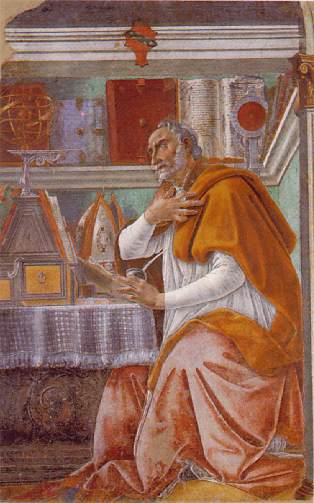
"St. Augustine of Hippo," by Botticelli
Today we celebrate the feast of the great Bishop and Doctor of the Church, St. Augustine of Hippo (354 AD - 430 AD). According to the Catholic Encyclopedia, "[t]he
great St. Augustine's life is unfolded to us in documents of unrivaled
richness, and of no great character of ancient times have we information
comparable to that contained in the "Confessions", which relate the
touching story of his soul, the "Retractations," which give the
history of his mind, and the "Life of Augustine," written by his
friend Possidius, telling of the saint's apostolate." It is mostly due to his "Confessions," the first autobiography written in the West and a model for many later writers, that St. Augustine is so well known to moderns. However, similarities in the atmosphere of our times and those of St. Augustine also form the basis for a sort of spiritual kinship with the great saint. Like us, St. Augustine lived in the shadow of a great civilization's collapse. Indeed, Augustine died as his episcopal see of Hippo Regius was under siege by Vandals, and defended by Goths, both of whom were heretical Arians. Although he was greatly anguished by the suffering occasioned by the sack of Rome and similar disasters, in his great work "The City of God," St. Augustine consoled Christians with the thought that, even if the
earthly rule of the Empire was imperiled, the City of God would
ultimately triumph. St. Augustine counseled Christians to keep their gaze fixed on Heaven, which became a standard Christian theme throughout Late Antiquity.
The following excerpt from "The Confessions" is taken from the Office of Readings for the feast:
Urged to
reflect upon myself, I entered under your guidance the innermost places of my
being; but only because you had become my helper was I able to do so. I
entered, then, and with the vision of my spirit, such as it was, I saw the
incommutable light far above my spiritual ken and transcending my mind: not
this common light which every carnal eye can see, nor any light of the same
order; but greater, as though this common light were shining much more
powerfully, far more brightly, and so extensively as to fill the universe. The
light I saw was not the common light at all, but something different, utterly
different, from all those things. Nor was it higher than my mind in the sense
that oil floats on water or the sky is above the earth; it was exalted because
this very light made me, and I was below it because by it I was made. Anyone
who knows truth knows this light.
St. Augustine of Hippo, pray for us.


