Thursday, September 27, 2012

Catholic Faux Folk Music - Why won't it go away?

"Monks in Choir"
I'll bet this was prayerful


Sr. Joan L. Roccasalvo, C.S.J., who holds a doctorate in musicology, in addition to degrees in philosophy (Ph.L), theology (M.A.), and the dreaded liturgical studies (Ph.D), provides her highly educated views on the marked decline in quality of Catholic liturgical music here

Best part is this quotation from Franz Josef van Beeck, S.J.:

The single most dangerous threat to the new liturgy is prayerlessness (whether of the authorized or the experimental variety). This is not a theoretical observation but a practical one.  Prayerlessness in the liturgy, in fact, is so widespread as to be almost taken for granted.

True dat.

Hail, Vincent, Priest

St. Vincent de Paul


Today we celebrate the feast of St. Vincent de Paul (1580 AD - 1660 AD).   From a peasant family in Gascony, Vincent was an exceptionally intelligent youth who entered the seminary at Toulouse and was ordained in 1600.   Though he would spend his life in service to France's orphans, widows, and poor, found hospitals for the galley slaves of Paris and Marseilles, reform seminary training in France, and found two religious congregations, perhaps the most remarkable and telling episode in Vincent's life occurred shortly after he'd been ordained.  Travelling by sea from Toulouse to Marseilles, Vincent was captured by Turkish pirates and sold as a slave in Tunis.  Two years later, Vincent escaped from Tunis with his master, whom Vincent had converted.   The following account of these years comes from the life of St. Vincent compiled in 1748 by the Bishop of  Rodez:


By resignation to the divine will … .and ... meditation on the sufferings of Christ, [St. Vincent] learned to bear all his afflictions with comfort and joy, uniting himself in spirit with his Divine Redeemer, and ...copy[ing] in himself his lessons of perfect meekness, patience, silence and charity. [Vincent was sold] to a renegado Christian who came from Nice in Savoy. … This apostate had three wives, of which one, who was a Turkish woman, went often to the field where Vincent was digging, and out of curiosity would ask him to sing the praises of God. He used to sing to her with tears in his eyes, the psalm, Upon the rivers of Babylon, &c., the Salve Regina, and such like prayers. She was so much taken with our holy faith, and doubtless with the saintly deportment of the holy slave, that she never ceased repeating to her husband, that he had basely abandoned the only true religion, till, … without opening her own eyes to the faith, she made him enter into it himself. Sincerely repenting of his apostacy, he agreed with Vincent to make their escape together. They crossed the Mediterranean sea in a small light boat which the least squall of wind would overset; and they landed safe at Aigues-Mortes, near Marseilles, on the 28th of June, 1607, and thence proceeded to Avignon. The apostate made his abjuration in the hands of the [papal] vice-legate, and the year following went with Vincent to Rome, and there entered himself a penitent in the austere convent of the Fate-Ben-Fratelli, who served the hospitals according to the rule of St. John of God.

St. Vincent de Paul, pray for us.

Wednesday, September 26, 2012

Fr. Hugh Thwaites on Confession

Fr. Hugh Thwaites


Fr. Hugh Thwaites, SJ died last month at the age of 95.  Fr. Thwaites converted to Catholicism from Anglicanism as a soldier during World War II, and subsequently spent three years as a prisoner of the Japanese.  All who knew him speak of his gentleness, humility and penetrating spiritual insight.  Here is part of a talk by Fr. Thwaites on the sacrament of confession in which those qualities shine forth clearly.   Unlike the miasma produced by some morbid German theologians we might name, Fr. Thwaites' talk, though never more complicated than a child's catechism, demonstrates the power and clarity of simple Catholic orthodoxy.  Too bad we hear it preached so rarely.


Tuesday, September 18, 2012

The Liturgical Movement (Part 2)

Fr. Romano Guardini


Recently we discussed the "Liturgical Movement," which began in the 19th century seeking to reform liturgy by returning to a medieval model of worship.  In the 20th century this movement somehow lead to the Novus Ordo, which is about as medieval as spandex, though not nearly as elegant.  Perhaps the incongruity between modern civilization, which produces things like spandex, and medieval civilization, which produced things like the Cathedral at Chartres, is what doomed the Liturgical Movement from the start.

Fr. Romano Guardini, one of the leading figures in the Liturgical Movement, noted that "[r]eligion needs civilization" by which Guardini meant "works of art, science, social orders and the like."  Guardini goes on to say that:

"...generally speaking, a fairly high degree of genuine learning and culture is necessary . . . in order to keep spiritual life healthy.  By means of these two things spiritual life retains its energy, clearness, and catholicity.  Culture preserves spiritual life from the unhealthy, eccentric, and one-sided elements with which it tends to get involved only too easily.  Culture enables religion to express itself, and helps it to distinguish what is essential from what is nonessential, the means from the end, and the path from the goal.  The Church has always condemned every attempt at attacking science, art , property, and so on.  The same Church which so resolutely stress the "one thing necessary," and which upholds with the greatest impressiveness the teaching of the Evangelical counsels - that we must be ready to sacrifice everything for the sake of eternal salvation - nevertheless desires, as a rule, that spiritual life should be impregnated with the wholesome salt of genuine and lofty culture."

Part of our task, then, in restoring liturgy is to restore our civilization.  Seek beauty, knowledge, and truth, and thereby sow the seeds of liturgical revival.

Monday, September 17, 2012

Hail, Robert, Catechist and Doctor of the Church

Tomb of St. Robert Bellarmine, Church of St. Ignatius, Rome


Today is the feast of St. Robert Bellarmine, Jesuit theologian, cardinal and preacher (1542 AD - 1621 AD).  The following is taken from St. Robert's "Ascent of the Mind to God:"

... [T]he commandments of God perfect the man who obeys them. They provide him with what he needs. They instruct and enlighten him and make him good and blessed. If you are wise, then, know that you have been created for the glory of God and your own eternal salvation. This is your goal; this is the center of your life; this is the treasure of your heart. If you reach this goal, you will find happiness. If you fail to reach it, you will find misery.

St. Robert Bellarmine, pray for us.


Saturday, September 15, 2012

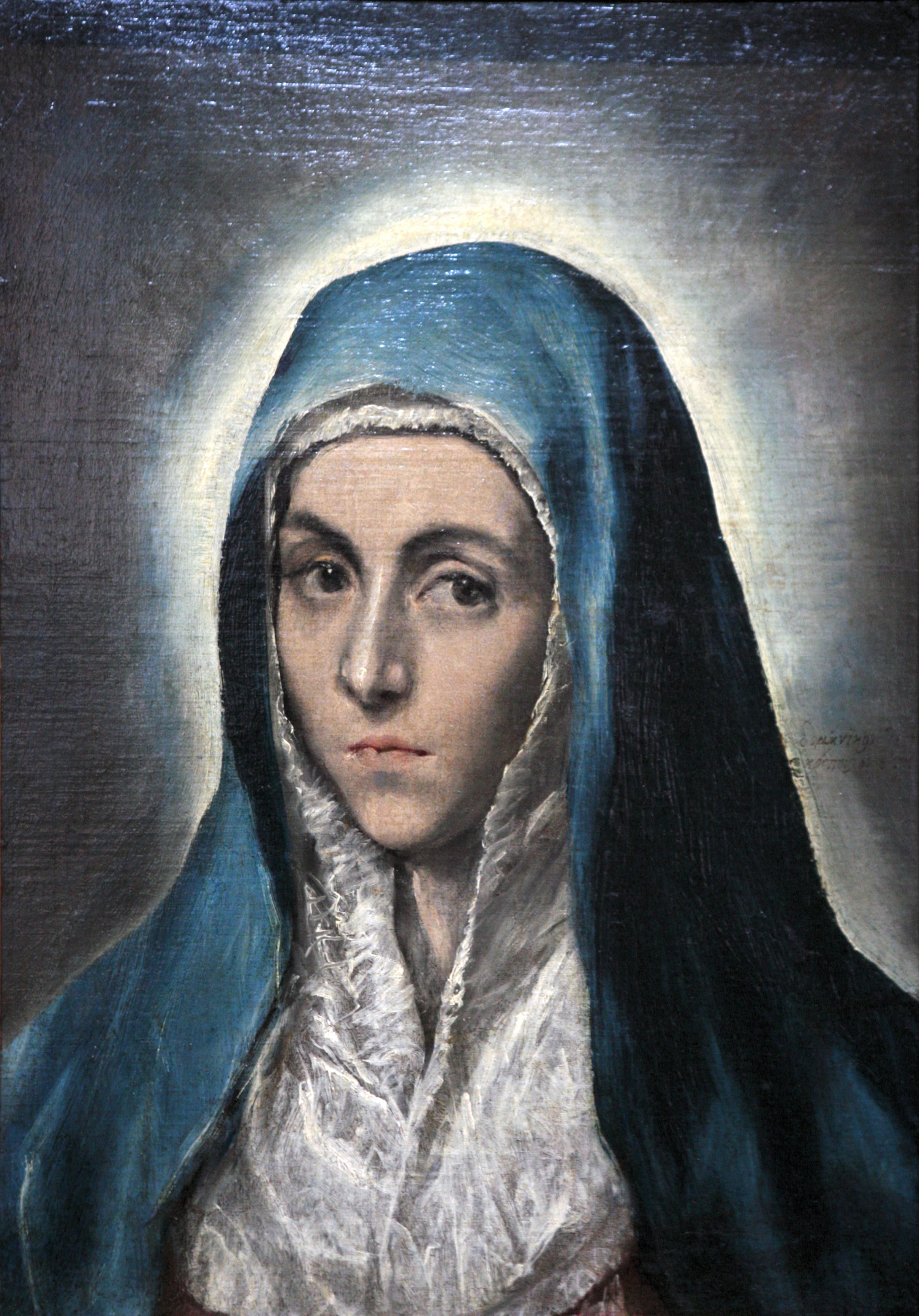
Our Lady of Sorrows

"Our Lady of Sorrows," El Greco

Today is the feast of Our Lady of Sorrows.   You may read a post with the full history of the feast (and a rarely seen Van Gogh Pieta) here.

The following comes from the Office of Readings for the feast, and is taken from a sermon by St. Bernard:

Perhaps someone will say: “Had she not known before that he would not die?” Undoubtedly. “Did she not expect him to rise again at once?” Surely. “And still she grieved over her crucified Son?” Intensely. Who are you and what is the source of your wisdom that you are more surprised at the compassion of Mary than at the passion of Mary’s Son? For if he could die in body, could she not die with him in spirit? He died in body through a love greater than anyone had known. She died in spirit through a love unlike any other since his.


Our Lady of Sorrows, pray for us.

Friday, September 14, 2012

Happy Roodmas Day!

"The Finding of the True Cross"  Agnolo Gaddi


Today is the feast of the Exaltation of the Holy Cross, or Roodmas Day.  It commemorates the dedication of the Basilica of the Resurrection in Jerusalem, built by Constantine's mother, St. Helena, in 355 AD.  It also celebrates the finding of the True Cross, which happened during the Basilica's construction.  You may read my condensed but charming and highly edifying re-telling of the story of the Feast here.

If today is the feast of the Exaltation of the Holy Cross, then Michaelmas Embertide is very near!  Wednesday, Friday, and Saturday after the Feast of the Exaltation of the Holy Cross are known as “Michaelmas Embertide.”  They come near the beginning of Autumn (September 22nd) and were formerly set aside as days of fasting and abstinence.  It's still a fruitful spiritual practice.  You may read more about that here.