Tuesday, October 4, 2011

"What did they do to this church?"

                                                          Liturgical dance - is it ever good?

A lot, and it's all bad.  Luckily, a bishop was visiting so they couldn't get really crazy. 
h/t Rorate Caeli

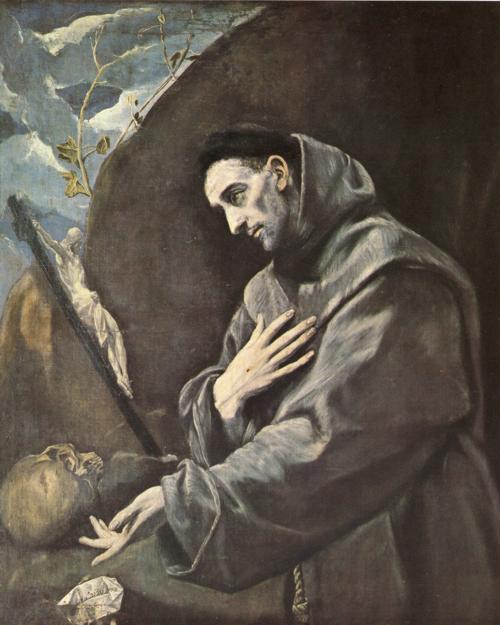
Hail, saintly Mystic, Stigmatic and Man of God

                                              "St. Francis in Meditation," by El Greco

Today we celebrate the feast of St. Francis of Assisi  (1181/1182 AD - 1226 AD).  The beauty, power and importance of St. Francis eludes summarization.   Rather, the legacy of St. Francis remains a vital one, and this most  loveable and provocative saint continues to pose great questions to us, as  G. K. Chesterton notes:

... there is a fascinating inconsistency in the position of Saint Francis.  He expressed in loftier and bolder language than any earthly thinker the conception that laughter is as divine as tears.  He called his monks the mountebanks of God.  He never forgot to take pleasure in a bird as it flashed past him, or a drop of water as it fell from his finger: he was, perhaps, the happiest of the sons of men.  Yet this man undoubtedly founded his whole polity on the negation of what we think the most imperious necessities; in his three vows of poverty, chastity, and obedience, he denied to himself and those he loved most, property, love, and liberty.  Why was it that the most large-hearted and poetic spirits in that age found their most congenial atmosphere in these awful renunciations?  Why did he who loved where all men were blind, seek to blind himself where all men loved?  Why was he a monk and not a troubadour?  These questions are far too large to be answered fully here, but in any life of Francis they ought at least to have been asked; we have a suspicion that if they were answered we should suddenly find that much of the enigma of this sullen time of ours was answered also.

St. Francis of Assisi, pray for us.

Some things are more important than freedom of conscience

For instance, contraception.  To the present administration, that is.  More here.

Monday, October 3, 2011

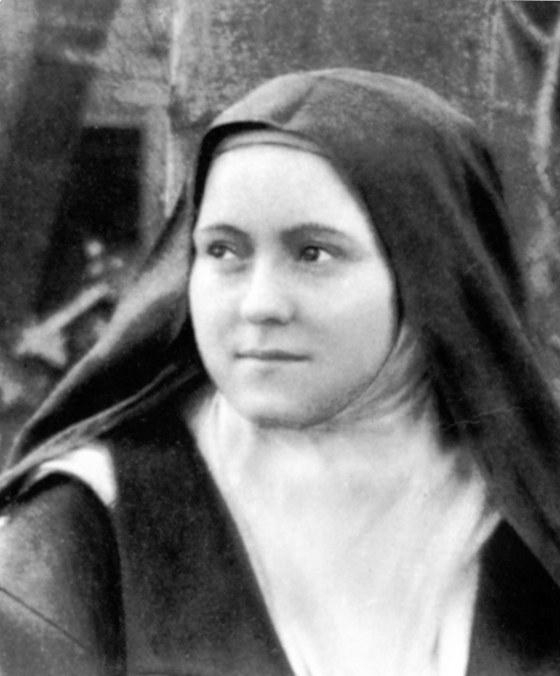
Hail, saintly "Little Flower" and Doctor of the Church


Saturday was the feast of St. Therese of Lisieux (1873 AD - 1897 AD).  St. Therese died of tuberculosis at the age of 24,  in the Carmelite convent she'd entered at the age of 15.  After such a short and hidden life, Therese might have been expected to pass quickly into obscurity.  However, the year after St. Therese's death her journal, which she'd kept in obedience to her superiors,  was published under the title "The Story of a Soul."  The work became hugely popular, and produced a great impact upon the Church and throughout the world.  St. Therese was beatified in 1923 and canonized in 1925 by Pope Pius XI, named co-patron of the missions (with St. Francis Xavier) in 1927, co-patron of France (with St. Joan of Arc) in 1944, and Doctor of the Church (the youngest person ever so honored) by Pope John Paul II in 1997.

The list of St. Therese's devotees is very long and varied.  It includes not only Mother Teresa of Calcutta, who chose Therese as her namesake because "she did ordinary things with extraordinary love," but also Edith Piaf, who believed herself cured of blindness through the intercession of St. Therese after a pilgrimage to Lisieux.  Indeed, the basilica of St. Therese in Lisieux is second in popularity only to Lourdes as a place of pilgrimage in France.

St. Therese teaches that the accomplishment of great deeds is not necessary to achieve sanctity.  What is required instead is to follow her "little way" of great love.  St. Therese writes:

"Love proves itself by deeds, so how am I to show my love? Great deeds are forbidden me. The only way I can prove my love is by scattering flowers and these flowers are every little sacrifice, every glance and word, and the doing of the least actions for love."

St. Therese of Lisieux, pray for us.


"Sacramental Thought"


We continue our review of Abbot Vonier's "A Key to the Doctrine of the Eucharist."   This is taken from Chapter 5, "Sacramental Thought:"

The stream of sacramental grace is truly the flow of the Blood of Christ: in one way or another every sacrament is the fire of Christ's love when He was dying on the Cross.

Perhaps the most satisfying line of sacramental thought is to visualize the sacraments as mysterious carriers of all the powers that are in Christ's death.  "The power of Christ's passion," say Saint Thomas, "is joined to us (copulatur nobis) through faith and through the sacraments, yet in different ways; for the contact (continuatio) which is through faith takes place through the act of the soul, but the contact which is through the sacraments takes place though the use of external things."

St. Thomas Aquinas, pray for us.

October is the month of the Holy Rosary

                                             "Virgin and Child with a Rosary" by Murillo


In 1883, Pope Leo XIII issued an encyclical dedicating the month of October to Our Lady of the Holy Rosary.  Pope Leo XIII is known as "the Rosary Pope" because he promulgated 11 encyclicals regarding this devotion.  In 1884, Pope Leo XIII further decreed that during the month of October five decades of the rosary were to be prayed daily in all parish churches and in all churches dedicated to the Mother of God.   Sadly, this practice appears to have died out.


Our Lady of the Rosary, pray for us.

Something is afoot in England

                                         Newman said his first Mass in England at Southwark


Londoners marked the first anniversaries of Benedict's visit and the beatification of John Henry Newman with a procession of the Blessed Sacrament from Westminster Cathedral to St. George's Cathedral, Southwark.

The latest green shoots of what we hope will become a beautiful spring for the Faith.

Blessed John Henry Newman, pray for us.