Showing posts with label St. Bonaventure. Show all posts

Tuesday, May 20, 2014

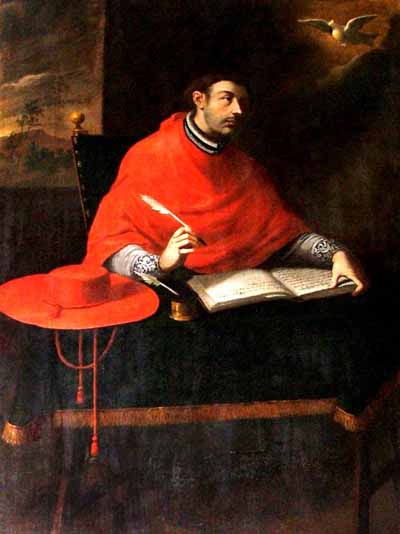
Pray without ceasing?


"St. Bonaventure in Prayer,"  Francisco de Zurbaran

St. Alphonsus Liguori has a lot to say about the importance of unceasing prayer, including this:

"How shall we win [happiness for all eternity]?  Only by prayer, says St. Augustine, and persevering prayer.  But how long must it last? As long as the struggle goes on.  Just as the contest never ceases, says St. Bonaventure, so we must never cease calling on God for His assistance, which is necessary for us so as not to succumb.  "Woe to them that have lost patience," says the Wise man (Eccls. 2:16), and have given up prayer.  Blessed shall we be "if we hold fast the confidence and glory of hope unto the end."  (Heb. 3:6)." 

St. Paul also tells us to "pray without ceasing."  A moment's reflection discloses that unceasing, lifelong praying is a lot of praying, though certain difficulties also come to mind, including the fact that many of us need to do other things besides praying from time to time.   So how can we possibly manage to pray without ceasing?   Luckily, there are a few tried and true ways to get started.  A monk from our local monastery recommended saying the rosary, which works for me.   There's also the Jesus Prayer, which is more popular amongst Orthodox Christians, but it's approved for Catholics, too.   As the Catechism of the Catholic Church says:


"The name of Jesus is at the heart of Christian prayer. All liturgical prayers conclude with the words 'through our Lord Jesus Christ'. The Hail Mary reaches its high point in the words 'blessed is the fruit of thy womb, Jesus'. The Eastern prayer of the heart, the Jesus Prayer, says: 'Lord Jesus Christ, Son of God, have mercy on me, a sinner.' Many Christians, such as St Joan of Arc, have died with the one word 'Jesus' on their lips."

There are lots of good dvds on praying.  Here's a trailer for one called "A Surge of the Heart," which is how St. Therese of Liseux described prayer:


Praying without ceasing is like a lot of things.  To get anywhere, you have to make up your mind, get started, and then don't quit.  God will certainly do his part.

RELATED:
A praying success story.

Thursday, September 29, 2011

Happy Michaelmas Day!

                         "St. Michael the Archangel," Hamburg, Germany


Today is the feast of St. Michael the Archangel. It's also the feast of the Archangel Gabriel and the Archangel Raphael (see Catholic Encyclopedia articles here and here ).

Angels are not to be dismissed as trifling, pious whimsy.  Not only have angels inspired serious reflection from such fine theological minds as St. Basil, St. Robert Bellarmine and St. Bonaventure, but Catholic tradition has accorded them important offices.  For instance, tradition, in accordance with scripture, gives the following duties to St. Michael:


    - To fight against Satan.
    - To rescue the souls of the faithful from the power of the enemy, especially at the hour of death.
    - To be the champion of God's people, the Jews in the Old Law, the Christians in the New Testament; therefore he was the patron of the Church, and of the orders of knights during the Middle Ages.
    - To call away from earth and bring men's souls to judgment ("signifer S. Michael repraesentet eas in lucam sanctam", Offert. Miss Defunct. "Constituit eum principem super animas suscipiendas", Antiph. off. Cf. The Shepherd of Hermas, Book III, Similitude 8, Chapter 3).

It is fitting, then, on the feast of St. Michael the Archangel to pray: 


St. Michael the Archangel,
defend us in battle.
Be our defense against the wickedness and snares of the Devil.
May God rebuke him, we humbly pray,
and do thou,
O Prince of the heavenly hosts,
by the power of God,
thrust into hell Satan,
and all the evil spirits,
who prowl about the world
seeking the ruin of souls.  Amen


.

Thursday, July 28, 2011

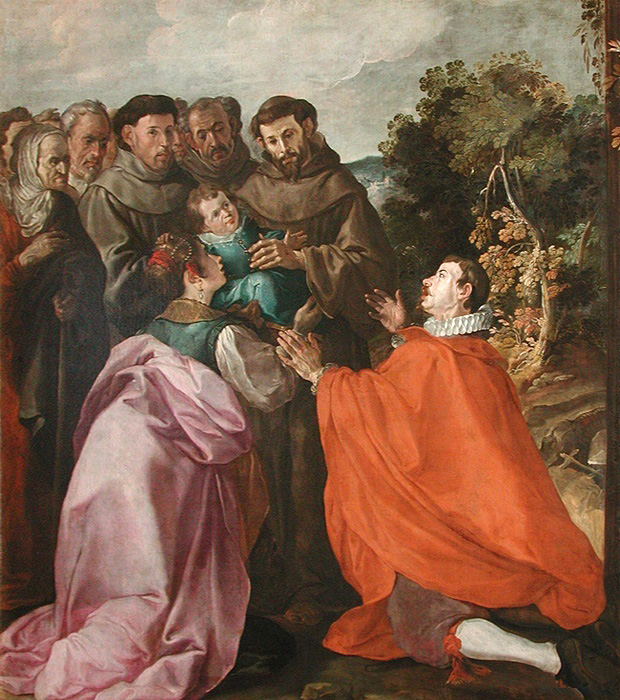
St. Bonaventure's "Life of St. Francis of Assisi"


                         "The healing of the child St. Bonaventure by St. Francis"


Earlier this month, we celebrated the feast of St. Bonaventure, and have been examining St. Bonaventure's contributions to the Church throughout the month.  

In 1260 AD, a general chapter of the Franciscan order requested St. Bonaventure to compose a life of St. Francis, of which there were then many in circulation.  St. Bonaventure duly composed "The Life of St. Francis," which was approved by a subsequent chapter as the standard biography of the saint, to the exclusion of all others.  The following is taken from St. Bonaventure's "The Life of St. Francis:"

And when the Brethren in council asked of him which virtue would render a man most pleasing unto Christ, he answered, as though laying bare the secret thought of his heart, "Ye know, Brethren, that poverty is an especial way of salvation, being as it were the food of humility, and the root of perfection, and her fruits are manifold, albeit hidden. For poverty is that treasure hid in a field of the Gospel, which to buy a man would sell all that he hath, and the things that cannot be sold are to be despised in comparison therewith."

Friday, July 22, 2011

St. Bonaventure's "Itinerarium Mentis ad Deum" (Part 3)


Here is the conclusion of St. Bonaventure's masterwork of mystical theology "Itinerarium Mentis ad Deum (the Journey of the Mind to God)."   St. Bonaventure's description of mystical encounter with God must finally conclude with Fire, death and holy silence.  This is taken from the chapter entitled "On The Mental And Mystical Excess, In Which, Rest Is Given To The Intellect, By An Affection Passing-Over Wholly Into God Through Excess:"


"Moreover if you seek, in what manner these things occur [fiant], interrogate grace, not doctrine, desire, not understanding [intellectum]; the groan of praying, not the study of reading; the spouse, not the teacher; God, not man, darkness, not brightness [claritatem]; not light, but the Fire totally inflaming, transferring one into God both by its excessive unctions and by its most ardent affections.  Which Fire indeed is God, and His forge is in Jerusalem, and Christ ignites [accendit] this in the fervor, of His most ardent Passion, which He alone truly perceived, who said: My soul has chosen suspense, and my bones death.  He who loves [diligit] this death can see God, because it is indubitably true: No man will see Me and live.  —  Therefore let us die and step into the darkness, let us impose silence upon our cares [sollicitudinibus], and concupiscences and phantasms; let us pass-over together with Christ Crucified from this world to the Father, that, by showing us the Father, we may say with Phillip: It suffices for us; let us hear with Paul: My grace is sufficient for you; let us exult with David saying: My flesh and my heart failed, God of my heart and my portion: God forever.  Blessed be the Lord forever, and every people shall say: Fiat, Fiat.  Amen"

Tuesday, July 19, 2011

St. Bonaventure's "Itinerarium Mentis ad Deum" (part 2)


"Itinerarium Mentis ad Deum" is St. Bonaventure's masterwork of mystical theology.   According to the Catholic Encyclopedia, mystical theology is "the science which treats of acts and experiences or states of the soul which cannot be produced by human effort or industry even with the ordinary aid of Divine grace."  A mystical theologian, then,  is not only a theologian but also a mystic; a person who has, by grace, been granted mystical union with God.  With the mystical theologian's assistance, those of us to whom the grace of mystical union has not been granted can still in some small measure appreciate the overpowering glory of the mystical experience.  In "Itinerarium," St. Bonaventure provides a mystically illuminated description of God, using theological terms and categories from Augustianian theology. The following excerpts from "Itinerarium" are from the chapter entitled "On The Sight Of The Divine Unity Through Its Primary Name, Which Is ‘Being’:"


"Moreover since it happens that God is contemplated not only outside of us and within us, but also above us: outside through vestige, within through image [imaginem] and above through the light, which has been marked upon our mind, which is the light of Eternal Truth, since  « our very mind is formed immediately by Truth Itself » (St. Augustine); ....


Whence it most truly appears, that « as the eye of the evening holds itself towards the light, so the eye of our mind holds itself towards the most manifest things of nature »; because accustomed [assuefactus] to the shadows of beings and to the phantasms of sensibles, when it looks upon [intuetur] the light itself of Most High ‘Being’, it seems to it that it sees nothing; not understanding, that that darkness is the Most High Illumination of our mind, just as, when the eye sees pure light, it seems to it that it sees nothing….


Whence if “God” names the primary, eternal, most simple, most actual, most perfect ‘being’; it is impossible that It is thought to not to be, nor to be but the Only One.  Listen therefore, O Israel, God thy God is one.  If you see this in the pure simplicity of (your) mind, you will in some wise [aliqualiter] be filled with the brightening of eternal light.


Returning again (to this) let us say: that therefore the most pure and absolute ‘being’, which is simply ‘being’, is primary and last, is for that reason the Origin and consummating End of all things.  —   Because It is eternal and most present, It for that reason comprises [ambit] and enters all durations, as if existing at the same time as their center and circumference.  —  Because It is most simple and the greatest, for that reason wholly within all and wholly outside, and through this « it is an intelligible sphere, whose center is everywhere and circumference nowhere ».  —  Because It is most actual and most immutable, for that reason « remaining stable It grants that all [universa] be moved ».  —  Because it is most perfect and immense, for that reason it is within all things, not as included, outside of all things, not as excluded, above all things, not as lifted up, below all things, not as prostrated.  —  On the other hand, because It is most highly one and in every measure, for that reason It is all in all [omnia in omnibus], although all things be many and It itself is not but one; and this, because through the most simple unity, the most serene truth, (and) the most sincere goodness there is in Him every virtuosity, every exemplarity and every communicability; and through this, from Him and through Him and in Him all things are, and this, because (He is) the omnipotent, omniscient and in every measure Good, which to see perfectly is to be blessed, as is said by Moses: I shall show thee every good."

Monday, July 18, 2011

St. Bonaventure's "Intinerarium Mentis ad Deum"


Last week we celebrated the feast of St. Bonaventure, and noted that he was honored with the title "Doctor of the Church" in recognition of his achievements in dogmatic, mystical, exegetical and homiletic theology.  What follows is a short sample of St. Bonaventure's famous treatise on mystical theology, "The Journey of the Mind to God."   The excerpt is taken from the second to last chapter, entitled "Of The Reflection Of The Most Blessed Trinity In Its Name, Which Is Good:"

If then you can look with the mind's eye upon the purity of goodness, which is the pure actualization of the principle of Charity, pouring forth free and due love, and both mingled together, which is the fullest diffusion according to nature and will--the diffusion as Word, in which all things are expressed, and as Gift, in which all other gifts are given--you may see by the highest communicability of the Good that a Trinity of Father and Son and Holy Spirit is necessary. Because of the greatest goodness, it is necessary that there be in them the greatest communicability, and out of the greatest communicability the greatest consubstantiality, and from the greatest consubstantiality the greatest configurability, and from all these the greatest coequality; and therefore the greatest coeternity as well as, because of all the aforesaid, the greatest co-intimacy, by which one is in the other necessarily through the highest degree of mutual penetration and one operates with the other through the complete identity of substances and power and operation of the most Blessed Trinity itself.

Friday, July 15, 2011

Hail, Saintly Cardinal-Bishop, Minister General and Doctor of the Church


Today we celebrate the feast of St. Bonaventure (1221 AD - 1274 AD), Cardinal-Bishop of Albano, Minister General of the Franciscans, and Doctor of the Church.  For his wise government of the Franciscan order as Minister General, a post St. Bonaventure assumed at the age of 35 and in which he continued until the final year of his life, St. Bonaventure is called the order's "Second Founder."  Pope Clement IV offered St. Bonaventure the archbishopric of York in 1265, but the humble saint declined.  In 1273, against his will, St. Bonaventure was made Cardinal-Bishop of Albano by Pope Gregory X.  In 1557, Pope Sixtus V honored St. Bonaventure for his great achievements in dogmatic, mystical, exegetical and homiletic theology by granting him the title "Doctor of the Church."

St. Bonaventure united in himself the most sublime features of the Middle Ages; tender piety and profound learning.   St. Bonaventure possessed a deep respect for traditio, and ever remained a faithful student of St. Augustine.  At the same time, St. Bonaventure drew freely from the newly re-discovered teachings of Aristotle.   Perhaps because Pope Benedict likewise combines piety and learning, and joins respect for traditio with zeal for authentic renewal, Sandro Magister refers to Benedict as "Bonaventurian."

From St. Bonaventure's "Life of St. Francis:"

"When the Brethren besought [St. Francis] to teach them to pray, he said: “When ye pray, say ‘our Father,’ and:’We adore Thee, O Christ, in all Thy churches that be in the whole world, and we bless Thee for that by Thy holy Cross Thou hast redeemed the world.”  Moreover, he taught them to praise God in all things and through all His creatures, to reverence priests with an especial honour, to firmly hold and simply confess the true faith, according as the Holy Roman Church doth both hold and teach it."

Tuesday, May 31, 2011

Feast of the Visitation of the Blessed Virgin Mary


                                         "The Visitation," Chartres Cathedral

Today is the Feast of the Visitation, which commemorates the second Joyful Mystery of the rosary, the Blessed Virgin's visit to her cousin Elizabeth.   At the time of the Visitation, Elizabeth was pregnant with John the Baptist, and Mary was pregnant with Jesus.  According to the Gospel of St. Luke, Elizabeth greeted Mary in this way:

And Elizabeth was filled with the Holy Ghost: And she cried out with a loud voice, and said: Blessed art thou among women, and blessed is the fruit of thy womb. And whence is this to me, that the mother of my Lord should come to me? For behold as soon as the voice of thy salutation sounded in my ears, the infant in my womb leaped for joy. And blessed art thou that hast believed, because those things shall be accomplished that were spoken to thee by the Lord.

 Mary responded with the "Magnificat:"

My soul doth magnify the Lord. And my spirit hath rejoiced in God my Saviour. Because he hath regarded the humility of his handmaid; for behold from henceforth all generations shall call me blessed. Because he that is mighty, hath done great things to me; and holy is his name. And his mercy is from generation unto generations, to them that fear him. He hath shewed might in his arm: he hath scattered the proud in the conceit of their heart. He hath put down the mighty from their seat, and hath exalted the humble. He hath filled the hungry with good things; and the rich he hath sent empty away. He hath received Israel his servant, being mindful of his mercy: As he spoke to our fathers, to Abraham and to his seed for ever.


The Feast of the Visitation was begun by St. Bonaventure in 1263 AD, and was extended to the entire Church in 1389. 

Let us pray with St. Athanasius:

O noble Virgin, truly you are greater than any other greatness. For who is your equal in greatness, O dwelling place of God the Word? To whom among all creatures shall I compare you, O Virgin? You are greater than them all, O Ark of the Covenant, clothed with purity instead of gold! You are the Ark in which is found the golden vessel containing the true manna, that is, the flesh in which Divinity resides.