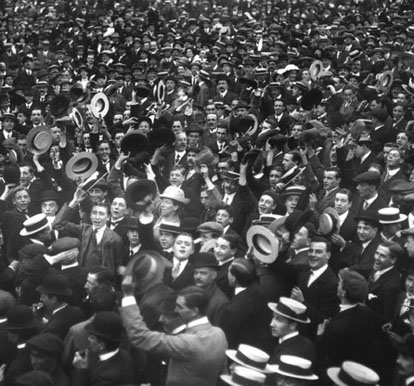
Crowds in Trafalgar Square cheering as Britain enters Great War, August 4, 1914
In London at midnight, one hundred years ago today, a British ultimatum demanding that Germany guarantee Belgian neutrality expired, causing a state of war to exist between the two nations. German troops then invaded Belgium, and the War, which had already flared in the Balkans, started in earnest.

Imperial War Dead Cemetery at Villers-Brettoneux
Of the 7 million killed in the war, about 1.2 million were from the British Empire, which at the time included Ireland. It takes more than 2,000 cemeteries in France and Belgium to hold them.
The title of this post is also the title of the War's best known poem, by Wilfred Owen. Owen lifted the line from one of Horace's Odes. The full line reads "Dulce et decorum est pro patria mori" which means "it is sweet and right to die for your country."
DULCE ET DECORUM EST
Bent double, like old beggars under sacks,
Knock-kneed, coughing like hags, we cursed through sludge,
Till on the haunting flares we turned our backs
And towards our distant rest began to trudge.
Men marched asleep. Many had lost their boots
But limped on, blood-shod. All went lame; all blind;
Drunk with fatigue; deaf even to the hoots
Of tired, outstripped Five-Nines that dropped behind.
Gas! Gas! Quick, boys! – An ecstasy of fumbling,
Fitting the clumsy helmets just in time;
But someone still was yelling out and stumbling,
And flound'ring like a man in fire or lime . . .
Dim, through the misty panes and thick green light,
As under a green sea, I saw him drowning.
In all my dreams, before my helpless sight,
He plunges at me, guttering, choking, drowning.
If in some smothering dreams you too could pace
Behind the wagon that we flung him in,
And watch the white eyes writhing in his face,
His hanging face, like a devil's sick of sin;
If you could hear, at every jolt, the blood
Come gargling from the froth-corrupted lungs,
Obscene as cancer, bitter as the cud
Of vile, incurable sores on innocent tongues,
My friend, you would not tell with such high zest
To children ardent for some desperate glory,
The old Lie; Dulce et Decorum est
Pro patria mori.
Wilfred Owen
Thought to have been written between 8 October 1917 and March, 1918
Thought to have been written between 8 October 1917 and March, 1918


