Showing posts with label El Greco. Show all posts

Tuesday, September 30, 2014

Hail, St. Jerome, translator and scholar


"St. Jerome", El Greco ca. 1600 AD

St. Jerome (347 AD - 420 AD) was the leading Biblical scholar of his day, and St. Jerome's translation of the Bible into Latin, known as the Vulgate, was not only a tremendous contribution to the Church but also a remarkable scholarly achievement, which displays not only deep knowledge of Biblical languages, but also a thorough understanding of the geography and history of the Holy Land.

The Vulgate formed an important part of the framework from which the Romance languages grew.   Words borrowed from Greek such as episcopus, presbyter, diaconus, Christus, Paraclitus, baptisma, anathema and Christian coinages such as Salvator, Incarnatio, Resurrectio, Trinitas, compassio, ingratitudo, immortalilas, impossibilitas would not have gained universal currency without the Vulgate.  More on the literary influence of St. Jerome here.


St. Jerome was a prickly man who did not relish criticism, a trait which made him many enemies and which shows clearly in his correspondence.  The following is taken from a letter from St. Jerome to St. Augustine of Hippo concerning the Septuagint.   St. Augustine considered the Septuagint, the translation of the Hebrew scriptures into Greek made by 70 translators in the 2nd century BC, to have been inspired, whereas St. Jerome believed only the scriptures themselves to have been inspired, not the translation. 

" ... [Y]ou ask why a former translation which I made of some of the canonical books was carefully marked with asterisks and obelisks, whereas I afterwards published a translation without these. You must pardon my saying that you seem to me not to understand the matter . .  . Do you wish to be a true admirer and partisan of the Seventy translators? Then do not read what you find under the asterisks; rather erase them from the volumes, that you may approve yourself indeed a follower of the ancients. If, however, you do this, you will be compelled to find fault with all the libraries of the Churches; for you will scarcely find more than one manuscript here and there which has not these interpolations."

Tuesday, June 24, 2014

Hail, St. John the Baptist, greatest man born of women

"St. John the Baptist," El Greco 1606 AD

Today is the Feast of the Birth of St. John the Baptist, who was descended, on his mother's side, from Aaron, the very first priest, and who was born to herald the new high priest, Jesus.  In this way, John the Baptist is the meeting point between the Old and New Covenants.   As St. Augustine says:


John . . . has been inserted as a kind of boundary between the two Testaments, the Old and the New. That he is somehow or other a boundary is something that the Lord himself indicates when he says, The Law and the prophets were until John. So he represents the old and heralds the new. Because he represents the old, he is born of an elderly couple; because he represents the new, he is revealed as a prophet in his mother’s womb. You will remember that, before he was born, at Mary’s arrival he leapt in his mother’s womb. Already he had been marked out there, designated before he was born; it was already shown whose forerunner he would be, even before he saw him. These are divine matters, and exceed the measure of human frailty.


Since the significance of St. John exceeds human measure, maybe it's best to close with a poem.

St. John, strong Baptist,
Angel before the face of the Messiah
Desert-dweller, knowing the solitudes that lie
Beyond anxiety and doubt,
Eagle whose flight is higher than our atmosphere
Of hesitation and surmise,
You are the first Cistercian and the greatest Trappist:
Never abandon us, your few but faithful children,
For we remember your amazing life,
Where you laid down for us the form and pattern of
Our love for Christ,
Being so close to Him you were His twin.
Oh buy us, by your intercession, in your mighty heaven,
Not your great name, St. John, or ministry,
But oh, your solitude and death:
And most of all, gain us your great command of graces,
Making our poor hands also fountains full of life and wonder
Spending, in endless rivers, to the universe,
Christ, in secret, and His Father, and His sanctifying Spirit.

(from "St. John the Baptist", by Thomas Merton)

Tuesday, April 17, 2012

"On avoiding the occasions of sin"

 "St. Paul,"  El Greco

The following is taken from a sermon for the First Sunday after Easter by our Eastertide guide, St. Alphonsus Liguori, Doctor of the Church:

"In consequence of original sin, we all have an inclination to do what is forbidden.   Hence St. Paul complained, that he experienced in himself a law opposed to reason.  "But I see another law in my members, fighting against the law of my mind, and captivating me in the law of sin." - Rom., vii 23.   Now, when a dangerous occasion is present, it violently excites our corrupt desires, so that it is then very difficult to resist them; because God withholds efficacious helps from those who voluntarily expose themselves to the occasion of sin.  "He that loveth danger shall perish in it" - Eccl., iii, 27.  "When", says St. Thomas, in his comment on this passage, "we expose ourselves to danger, God abandons us in it".  St. Bernardine of Sienna teaches, that the counsel of avoiding the occasions of sin, is the best of all counsel, and as it were the foundation of religion."

St. Alphonsus Liguori, pray for us.

Thursday, April 12, 2012

"On the miserable state of relapsing sinners" (part 3)

"The Repentant St. Peter," El Greco
 
The following is taken from a sermon for Easter Sunday by our Eastertide guide, St. Alphonsus Liguori, Doctor of the Church:

"Let us, then, brethren, tremble at the thought of relapsing into sin, and let us beware of availing ourselves of the mercy of God to continue to offend him.  "He", says St. Augustine, "who has promised pardon to penitents, has promised repentance to no one."  God has indeed promised to pardon all who repent of their sins; but he has not promised to any one the grace to repent of the faults which he has committed.  Sorrow for sin is a pure gift of God: if he withholds it, how will you repent?  And without repentance, how can you obtain pardon? . . . . St. Isidore tells us, that the man who repeats the sin which he before detested, is not a penitent but a scoffer of God's majesty. . . . And Tertullian teaches, that, where there is no amendment, repentance is not sincere."


St. Alphonsus Liguori, pray for us.

Saturday, December 24, 2011

Christmas Eve Fast

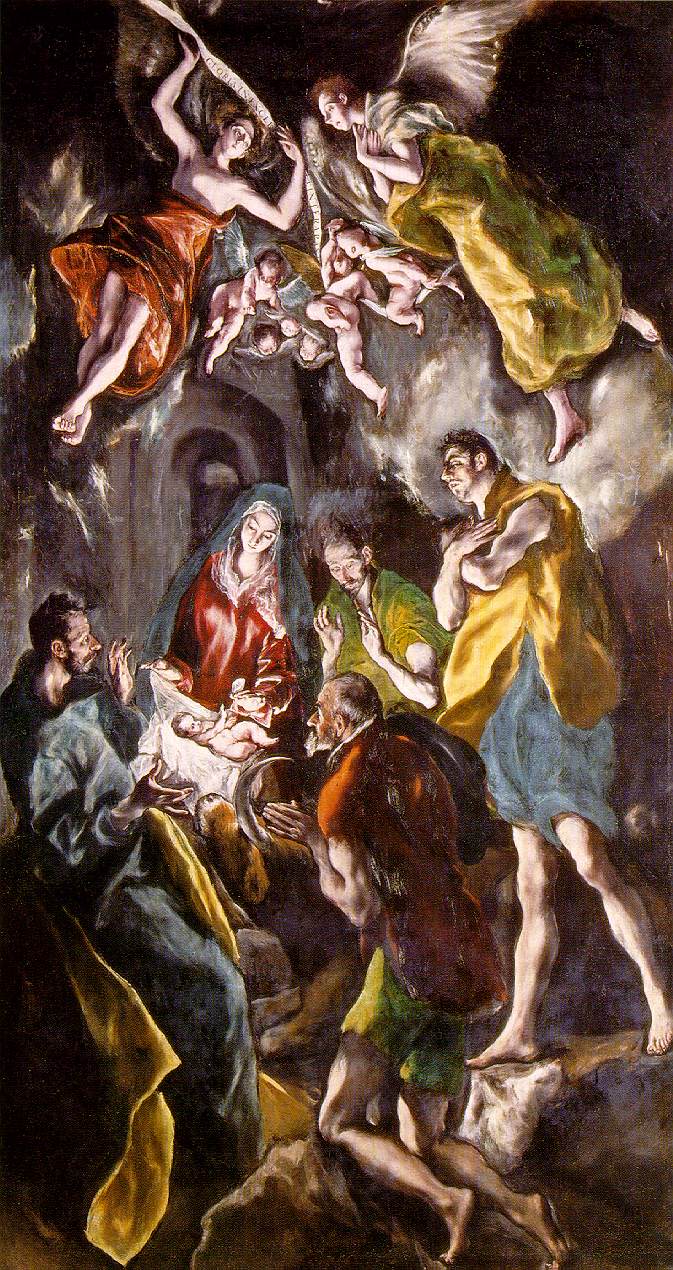
"Adoration of the Shepherds", by El Greco

For those of you inclined to keep pre-1965 customs of the Church; until the mid 1960s, Dec 23 and Dec 24 were days of fast and abstinence.   In my opinion, a fitting end to a penitential Advent.

Lift up your heads, for your redemption is at hand.

Wednesday, November 30, 2011

Hail, Andrew, Apostle and Martyr

"St. Andrew," by El Greco

                                                           
 Today the Church celebrates the feast of St. Andrew (d. 60 AD).  St. Andrew, the brother of St. Peter, was from Galilee, and like his brother was a fisherman.  In the Orthodox tradition, he is known as the "Protokletos" meaning "the first-called."  According to the Gospel of St. John, Andrew was a disciple of John the Baptist, and was led by John's preaching to follow Jesus.   Recognizing Jesus as the Messiah, St. Andrew hastened to introduce Him to his brother.   In the New Testament, St. Andrew is always numbered among the first four Apostles.

According to tradition, St. Andrew was the first bishop of Byzantium, and preached along the Black Sea and Volga River as far as Novgorod.   St. Andrew was martyred upon a saltire, or X-shaped cross, at Patrae in what is now Greece, where his relics were kept until transferred to Constantinople in 357 AD.   When French crusaders captured Constantinople in the thirteenth century, many of St. Andrew's relics were carried to Rome.  In 1461 AD, after the fall of Constantinople to the Ottoman Turks, the head of St. Andrew was given by Michael Paleologus to Pope Pius II, who enshrined it in one of the four central pillars of St. Peter's Basilica.   As a gesture of goodwill, in 1964 Pope Paul VI returned all of St. Andrew's relics to the Greek Orthodox church, and they are now kept again at Patrae.

There is a legend that in the 10th century, relics of St. Andrew were supernaturally transported to what is now the town of St. Andrew's in Scotland.  Wikipedia relates the following additional legend regarding St. Andrew and Scotland:

"[I]n 832 AD, Óengus II led an army of Picts and Scots into battle against the Angles, led by Æthelstan, near modern-day Athelstaneford, East Lothian.  The legend states that whilst engaged in prayer on the eve of battle, Óengus vowed that if granted victory he would appoint Saint Andrew as the Patron Saint of Scotland. On the morning of battle white clouds forming an X shape in the sky were said to have appeared.  Óengus and his combined force, emboldened by this apparent divine intervention, took to the field and despite being inferior in terms of numbers were victorious.  Having interpreted the cloud phenomenon as representing the crux decussata upon which Saint Andrew was crucified, Óengus honoured his pre-battle pledge and duly appointed Saint Andrew as the Patron Saint of Scotland. The white saltire set against a celestial blue background is said to have been adopted as the design of the flag of Scotland on the basis of this legend."


St. Andrew, pray for us. 

Monday, May 16, 2011

A Poem in Honor of the Virgin Mary


Annunciation by El Greco

Annunciation

 by John Donne  (1572- 1631)

Salvation to all that will is nigh;
That All, which always is all everywhere,
Which cannot sin, and yet all sins must bear,
Which cannot die, yet cannot choose but die,
Lo, faithful virgin, yields Himself to lie
In prison, in thy womb; and though He there
Can take no sin, nor thou give, yet He will wear,
Taken from thence, flesh, which death's force may try.
Ere by the spheres time was created, thou
Wast in His mind, who is thy Son and Brother;
Whom thou conceivst, conceived; yea thou art now
Thy Maker's maker, and thy Father's mother;
Thou hast light in dark, and shutst in little room,
Immensity cloistered in thy dear womb.