Showing posts with label St. Augustine. Show all posts

Tuesday, June 24, 2014

Hail, St. John the Baptist, greatest man born of women

"St. John the Baptist," El Greco 1606 AD

Today is the Feast of the Birth of St. John the Baptist, who was descended, on his mother's side, from Aaron, the very first priest, and who was born to herald the new high priest, Jesus.  In this way, John the Baptist is the meeting point between the Old and New Covenants.   As St. Augustine says:


John . . . has been inserted as a kind of boundary between the two Testaments, the Old and the New. That he is somehow or other a boundary is something that the Lord himself indicates when he says, The Law and the prophets were until John. So he represents the old and heralds the new. Because he represents the old, he is born of an elderly couple; because he represents the new, he is revealed as a prophet in his mother’s womb. You will remember that, before he was born, at Mary’s arrival he leapt in his mother’s womb. Already he had been marked out there, designated before he was born; it was already shown whose forerunner he would be, even before he saw him. These are divine matters, and exceed the measure of human frailty.


Since the significance of St. John exceeds human measure, maybe it's best to close with a poem.

St. John, strong Baptist,
Angel before the face of the Messiah
Desert-dweller, knowing the solitudes that lie
Beyond anxiety and doubt,
Eagle whose flight is higher than our atmosphere
Of hesitation and surmise,
You are the first Cistercian and the greatest Trappist:
Never abandon us, your few but faithful children,
For we remember your amazing life,
Where you laid down for us the form and pattern of
Our love for Christ,
Being so close to Him you were His twin.
Oh buy us, by your intercession, in your mighty heaven,
Not your great name, St. John, or ministry,
But oh, your solitude and death:
And most of all, gain us your great command of graces,
Making our poor hands also fountains full of life and wonder
Spending, in endless rivers, to the universe,
Christ, in secret, and His Father, and His sanctifying Spirit.

(from "St. John the Baptist", by Thomas Merton)

Tuesday, May 20, 2014

Pray without ceasing?


"St. Bonaventure in Prayer,"  Francisco de Zurbaran

St. Alphonsus Liguori has a lot to say about the importance of unceasing prayer, including this:

"How shall we win [happiness for all eternity]?  Only by prayer, says St. Augustine, and persevering prayer.  But how long must it last? As long as the struggle goes on.  Just as the contest never ceases, says St. Bonaventure, so we must never cease calling on God for His assistance, which is necessary for us so as not to succumb.  "Woe to them that have lost patience," says the Wise man (Eccls. 2:16), and have given up prayer.  Blessed shall we be "if we hold fast the confidence and glory of hope unto the end."  (Heb. 3:6)." 

St. Paul also tells us to "pray without ceasing."  A moment's reflection discloses that unceasing, lifelong praying is a lot of praying, though certain difficulties also come to mind, including the fact that many of us need to do other things besides praying from time to time.   So how can we possibly manage to pray without ceasing?   Luckily, there are a few tried and true ways to get started.  A monk from our local monastery recommended saying the rosary, which works for me.   There's also the Jesus Prayer, which is more popular amongst Orthodox Christians, but it's approved for Catholics, too.   As the Catechism of the Catholic Church says:


"The name of Jesus is at the heart of Christian prayer. All liturgical prayers conclude with the words 'through our Lord Jesus Christ'. The Hail Mary reaches its high point in the words 'blessed is the fruit of thy womb, Jesus'. The Eastern prayer of the heart, the Jesus Prayer, says: 'Lord Jesus Christ, Son of God, have mercy on me, a sinner.' Many Christians, such as St Joan of Arc, have died with the one word 'Jesus' on their lips."

There are lots of good dvds on praying.  Here's a trailer for one called "A Surge of the Heart," which is how St. Therese of Liseux described prayer:


Praying without ceasing is like a lot of things.  To get anywhere, you have to make up your mind, get started, and then don't quit.  God will certainly do his part.

RELATED:
A praying success story.

Friday, April 20, 2012

"On avoiding the occasions of sin" (conclusion)

"Allegory of Perseverance,"  Giovanni Bellini


The following is taken from a sermon for the First Sunday after Easter by our Eastertide guide, St. Alphonsus Liguori, Doctor of the Church:

"If we wish to save our souls from sin and Hell, we must always fear and tremble.  "With fear and trembling work out your salvation" - Phil. ii. 12.  He who is not fearful, but exposes himself to occasions of sin, shall scarcely be saved.  . . . We cannot merit the grace of perseverance; but, according to St. Augustine, God grants it to every one that asks it, because he has promised to hear all who pray to him."

St. Alphonsus Liguori, pray for us.

Thursday, April 19, 2012

"On avoiding the occasions of sin" (Part 2)

"The Virgin Appearing to St. Philip Neri"  G. B. Piazzetta


The following is taken from a sermon for the First Sunday after Easter by our Eastertide guide, St. Alphonsus Liguori, Doctor of the Church:

"Impurity, say St. Augustine, is a vice which makes war on all, and which few conquer.  "The fight is common; but the victory rare."  . . . . St. Philip Neri used to say, that in the war against the vice of impurity, the victory is gained by cowards - that is, by those who fly from the occasions of this sin.  . . . St. Bernard teaches, that to preserve chastity, and, at the same time, to expose oneself to the proximate occasion of sin, "is a greater miracle than to raise a dead man to life."


St. Alphonsus Liguori, pray for us.

Wednesday, March 14, 2012

Benedict XVI, Ecumenist

Pope Gregory the Great sending St. Augustine of Canterbury to convert England, (Westminster Cathedral)


An underappreciated facet of Benedict's papacy receives perceptive consideration from Sandro Magister.

Wednesday, December 7, 2011

Hail, St. Ambrose, Bishop and Doctor


      Body of St. Ambrose (white vestments)

Today the Church celebrates the feast of St. Ambrose of Milan ( 340 AD - 397 AD).  St. Ambrose was born in Trier, the son of a high Roman official, and was educated at Rome for a career in the service of the empire.   While governor of Liguria, in Northern Italy, Ambrose intervened in a dispute between Catholics and Arians regarding who should fill the vacant archbishopric of Milan.  As Ambrose was in the midst of his address to the disputing parties, both sides spontaneously sought to acclaim Ambrose himself bishop.   Ambrose declined forcefully, feeling himself unprepared for such an office, because, although a Christian, he had neither been baptized nor ordained.  However, Emperor Gratian supported the idea, and Ambrose soon relented.  Within seven days, Ambrose was baptized, ordained and installed as bishop of Milan.   Ambrose gave his property to the poor, and his land to the Church.   As bishop, Ambrose was not only an excellent administrator, but also a pre-eminent expositor of the Faith.  "He was one of those", said St. Augustine, "who speak the truth, and speak it well, judiciously, pointedly, and with beauty and power of expression."  Ambrose's manner of life was notable for its simplicity.  His door was open to all, and any time not taken up with ecclesiastical business was generally devoted to reading or prayer.  Of St. Ambrose's writings, it has been noted that


"[Ambrose] is a genuine Roman in whom the ethico-practical note is always dominant. He had neither time nor liking for philosophico-dogmatic speculations. In all his writings he follows some practical purpose."
 
Ambrosian Chant, a method of chanting in which one side of the choir responds alternately to the other side,  is named in honor of St. Ambrose, although he was not the originator of this method of chant.  However, St. Ambrose did compose several hymns; you may listen to Michael Praetorius's version of Ambrose's Advent hymn, "Come, Thou Redeemer of the Earth" by clicking below:


St. Ambrose was also instrumental in the conversion of St. Augustine of Hippo, one of the greatest of all saints.  Augustine heard Ambrose preach and, impressed by Ambrose's great learning and intelligence, (the first Christian ever to so impress Augustine) resolved to meet him.  St. Ambrose proved to be as kind as he was intelligent, and Ambrose's friendship and saintly example were powerful inducements toward Augustine's eventual baptism.

St. Ambrose's remains may be viewed at the Cathedral in Milan.  It is one of the oldest extant bodies of an historical personage known.

St. Ambrose, pray for us.


Thursday, September 22, 2011

"Without justice what else is the state ..."

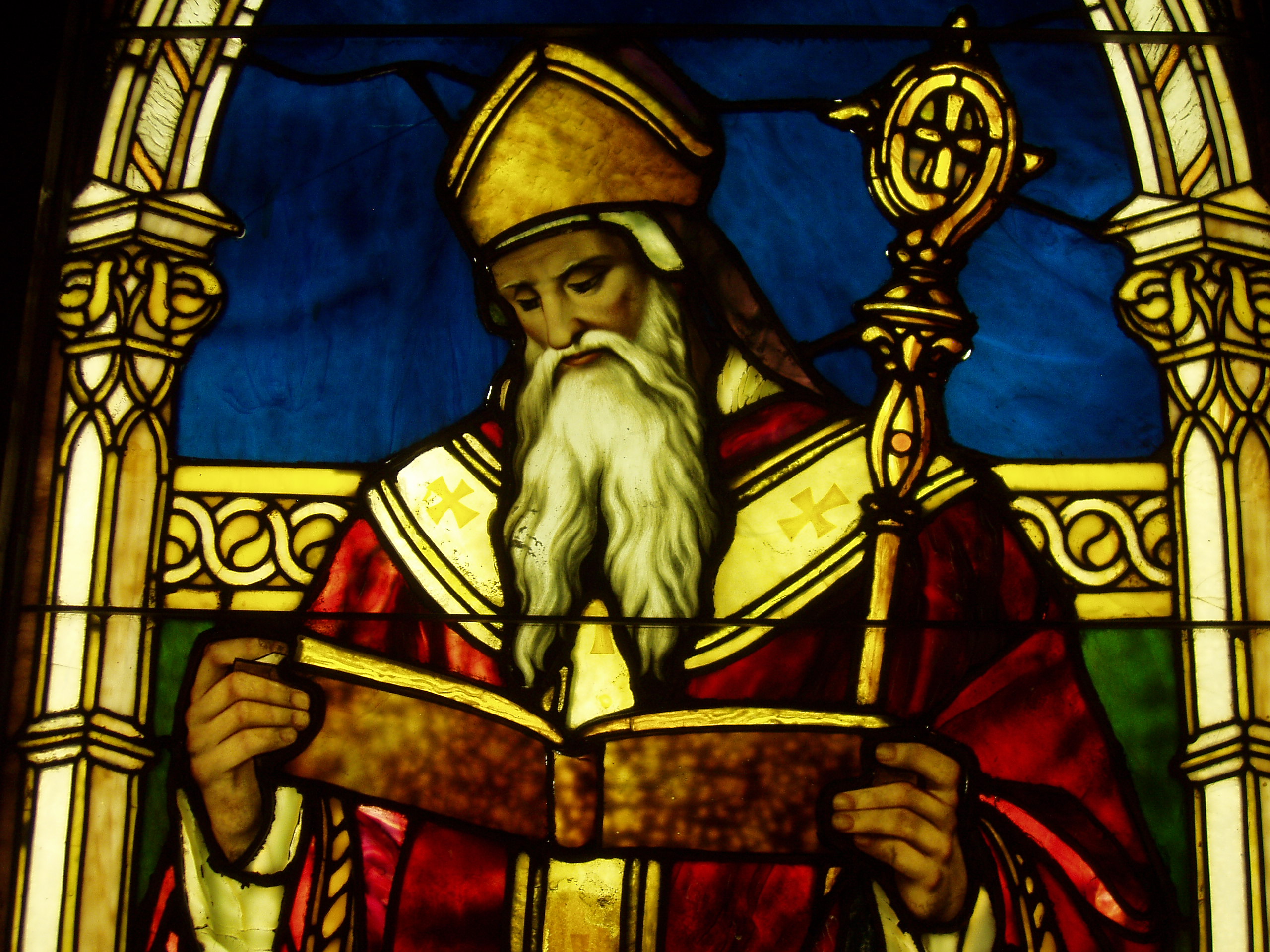
                                         "St. Augustine"  window by Tiffany, Lightner Museum, St. Augustine FL


".. . but a great band of robbers?"  So asked St. Augustine, and Benedict repeated the question in his address to the Bundestag today.

St. Augustine, pray for us.

Friday, July 1, 2011

Devotion to the Sacred Heart of Jesus (Part 13)


Today is the Feast of the Sacred Heart of Jesus.  We have been paying particular attention to devotion to the Sacred Heart throughout the month of June.  See a review of previous posts here and here.

The following is taken from a meditation for the Feast of the Sacred Heart by St. Margaret Mary Alacoque:

"Consider that union of hearts is the ultimate effect towards which love tends.  This union of hearts was the object which Jesus Christ had in mind when he instituted the Blessed Eucharist.  In this adorable Mystery, He acts like one passionately inflamed with love for men, since in It love makes Him in a manner go out of Himself in order to live only in the object of His love.  "At this holy Table," said St. Augustine, "Christ has consecrated the Mystery of union with us."