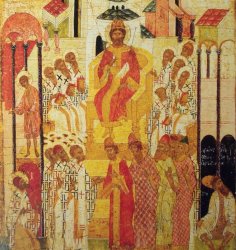
Council of Nicaea
When the latest translation of the Novus Ordo entered general use a couple of years ago, some objected that the word "consubstantial," which the new translation of the Creed used in place of the former phrase "one in being," was too esoteric for an ordinary Catholic to understand. This contention no doubt shocked today's saint, Athanasius of Alexandria, since he'd been involved in a major controversy for most of his life which centered upon consubstantiality. Athanasius even suffered exile on five separate occasions for defending orthodox teaching on consubstantiality. Strictly speaking, however, Athanasius wouldn't know much about "consubstantial," or even "one in being", as he would have used the original and even more exotic sounding Greek term, which is homoousia.
The homoousia controversy arose when a presbyter named Arius (like Athanasius, also from Alexandria) began pressing his view that God the Father and the Son did not exist together eternally. Jesus, according to Arius, was a divine being, but inferior to God the Father, since Jesus had been created by him. Many agreed with Arius, and the rift between the followers of Arius and orthodox believers created so many problems for the Emperor Constantine that he called the Council of Nicaea (325 AD) to settle the issue.
At the Council, the followers of Arius argued that Christ was not of the same essence or being with God the Father: the Father and the Son, according to Arians, were of merely "like" essence,
or being (homoiousia).
Athanasius, on the other hand, was a forceful proponent of "the tradition, teaching, and faith proclaimed by the
apostles and guarded by the fathers" which held that the Son of
God was of the same essence or being with the Father (homoousia). There was no word for this idea in Latin, so Tertullian had earlier coined the term consubstantialis to translate it.
The council fathers, as well as the Emperor Constantine, endorsed the traditional teaching that God the Father and God the Son are of the same essence or being. The council even anathematized those holding to the teachings of Arius, but this didn't end the controversy, partly because Constantine would be succeeded by emperors who shared Arius's views. As a result, Athanasius would spend most of the remaining 53 years of his life fighting the Arian heresy. 17 of those years were spent in exile at the hands of Arian emperors.
Within the Roman empire, the controversy over Arianism ended with the adoption of the Nicene Creed at the Second Council of Nicaea in 381 AD. However, the Council's edicts had no effect upon some barbarian tribes in the west, in particular the Vandals, who held to their Arian views and continued to persecute orthodox Christians until they themselves were absorbed into the empire in the 7th century AD. Arianism persists today among Unitarians and the Jehovah's Witnesses. Indeed, the Witnesses regard Arius as a forerunner of Charles Taze Russell, the founder of their movement. The next time a Witness rings your doorbell, you can point out that their Christology was condemned by two ecumenical councils more than 16 centuries ago.
Though an uncompromising defender of orthodoxy, Athanasius was no mere fanatic. St. Gregory of Nazianzen says of Athanasius that he blended the
properties of two precious stones, and was a diamond to those who
struck him, and a magnet to those who differed from him, thus combining
"magnetic attractiveness with adamantine firmness.” And Athanasius bore his exiles and other sufferings with courage and good humor. For example, when the Emperor Julian sought to arrest him, Athanasius fled up the Nile in a boat, with the Emperor's forces in pursuit. When his boat was hailed by an imperial vessel which inquired where Athanasius was, Athanasius himself replied "he is not far off."
This is taken from an Orthodox hymn to St. Athanasius:
O Holy father Athanasius,
like a pillar of
orthodoxy
you refuted the
heretical nonsense of Arius
by insisting that
the Father and the Son are equal in essence.
O venerable
father, beg Christ our God to save our souls.


