Showing posts with label St. Thomas Aquinas. Show all posts

Friday, September 13, 2013

Increase your Catholic Wordpower: Acedia

Acedia


According to the Oxford Concise Dictionary of the Christian Church, acedia (or accidie) is "a state of restlessness and inability either to work or to pray".   It can be a precursor to sloth—one of the seven deadly sins.  St. Thomas Aquinas identified acedia with "the sorrow of the world" that "worketh death."
 

John Cassian, (ca. 360 AD - ca. 435 AD) a monk from Southern Gaul who introduced Eastern monasticism into the West, wrote a great deal about acedia, including the following:

"[Acedia is] what the Greeks call ἀκηδία, which we may term weariness or distress of heart. This is akin to dejection, and is especially trying to solitaries. . . [W]hen this has taken possession of some unhappy soul, it produces dislike of the place, disgust with the cell, and disdain and contempt of the brethren who dwell with him or at a little distance, as if they were careless or unspiritual. It also makes the man lazy and sluggish about all manner of work which has to be done within the enclosure of his dormitory. It does not suffer him to stay in his cell, or to take any pains about reading, and he often groans because he can do no good while he stays there, and complains and sighs because he can bear no spiritual fruit so long as he is joined to that society; and he complains that he is cut off from spiritual gain, and is of no use in the place, as if he were one who, though he could govern others and be useful to a great number of people, yet was edifying none, nor profiting any one by his teaching and doctrine."

Thursday, July 19, 2012

Shocking!

They have a lot to answer for


Study finds teenagers "can be corrupted" by Hollywood sex scenes!

It may surprise these researchers that many in the Church have been aware of this phenomenon for some time.

Hollywood corrupters can certainly profit from studying St. Thomas Aquinas' teachings on scandal, that is, "a word or action evil in itself, which occasions another's spiritual ruin" (h/t New Advent).

Thursday, January 12, 2012

Transubstantiation


According to the Catholic Catechism, the Eucharist is the source and summit of the Christian life - a sacrament of inexhaustible richness.  Though the Eucharist is a mystery, and therefore something we can never fully understand, the Church teaches very fully and clearly regarding the Eucharist, and we must strive to grasp this teaching as thoroughy as possible.  A very good source for this teaching is Abbot Vonier's magnificent text "A Key to the Doctrine of the Eucharist."  The following is taken from the chapter "Transubstantiation:"

"Wherever a priest, in the name of Christ, pronounces the sacramental consecration, the substance of the bread and the substance of the wine are changed into the substance of Christ's Body and the substance of Christ's Blood.  There is no bringing down from heaven of the Body and Blood of Christ; this is not the Eucharist; but Christ's Body and Christ's Blood are truly produced in an act of divine power, as grace is produced in the human soul at Baptism."

St. Thomas Aquinas, masterful teacher regarding the Eucharist, pray for us.

Thursday, December 15, 2011

"Whether Christ is sacrificed in this sacrament?"

Solemn Papal Mass


A recent poll suggests that half of American Catholics do not accept Church teaching concerning the Eucharist.   We believe this alarming state of affairs has arisen partly because the Mass in the US is typically conducted with less solemnity and reverence than the average Rotary Club luncheon.   Inadequate or non-existent catechesis is also partly to blame.  To remedy the doctrinal deficit, we have been transmitting the teaching of St. Thomas Aquinas regarding the Eucharist, as contained in the great instructional text St. Thomas composed for beginners, the Summa Theologica.  To the quaestio above, St. Thomas responds:

"The celebration of this sacrament is called a sacrifice for two reasons. First, because, as Augustine says (Ad Simplician. ii), "the images of things are called by the names of the things whereof they are the images; as when we look upon a picture or a fresco, we say, 'This is Cicero and that is Sallust.'" But, as was said above (Question 79, Article 1), the celebration of this sacrament is an image representing Christ's Passion, which is His true sacrifice. Accordingly the celebration of this sacrament is called Christ's sacrifice. Hence it is that Ambrose, in commenting on Hebrews 10:1, says: "In Christ was offered up a sacrifice capable of giving eternal salvation; what then do we do? Do we not offer it up every day in memory of His death?" Secondly it is called a sacrifice, in respect of the effect of His Passion: because, to wit, by this sacrament, we are made partakers of the fruit of our Lord's Passion. Hence in one of the Sunday Secrets (Ninth Sunday after Pentecost) we say: "Whenever the commemoration of this sacrifice is celebrated, the work of our redemption is enacted." Consequently, according to the first reason, it is true to say that Christ was sacrificed, even in the figures of the Old Testament: hence it is stated in the Apocalypse (13:8): "Whose names are not written in the Book of Life of the Lamb, which was slain from the beginning of the world." But according to the second reason, it is proper to this sacrament for Christ to be sacrificed in its celebration."

St. Thomas Aquinas, pray for us.

Tuesday, November 22, 2011

"Whether the whole Christ is contained under this sacrament?"


According to a recent poll of American Catholics, belief in fundamental Church teaching concerning the Eucharist has eroded to a shocking extent.  I suspect this erosion has two principal causes.  The first is the irreverence towards the Eucharist which the Novus Ordus makes possible, and perhaps even fosters.  The second, which is more easily remedied, is inadequate catechesis.  We have been addressing this second issue by periodically transmitting the teaching of St. Thomas Aquinas on the Eucharist as embodied in his teaching text "for beginners," the Summa Theologica.

To the quaestio above, St. Thomas responds:


"It is absolutely necessary to confess according to Catholic faith that the entire Christ is in this sacrament. Yet we must know that there is something of Christ in this sacrament in a twofold manner: first, as it were, by the power of the sacrament; secondly, from natural concomitance. By the power of the sacrament, there is under the species of this sacrament that into which the pre-existing substance of the bread and wine is changed, as expressed by the words of the form, which are effective in this as in the other sacraments; for instance, by the words: "This is My body," or, "This is My blood." But from natural concomitance there is also in this sacrament that which is really united with that thing wherein the aforesaid conversion is terminated. For if any two things be really united, then wherever the one is really, there must the other also be: since things really united together are only distinguished by an operation of the mind."

St. Thomas Aquinas, pray for us.

Tuesday, November 15, 2011

"Whether bread can be converted into the body of Christ?"

                                                                    St. Thomas Aquinas

According to a recent poll, half of American Catholics do not accept Church teaching concerning the Eucharist.   We believe this alarming state of affairs has arisen through inadequate or non-existent catechesis.  To remedy the doctrinal deficit, we have been transmitting the teaching of St. Thomas Aquinas regarding the Eucharist, as contained in the great instructional text St. Thomas composed for beginners, the Summa Theologica.  To the quaestio above, St. Thomas responds:


"[S]ince Christ's true body is in this sacrament, and since it does not begin to be there by local motion, nor is it contained therein as in a place, as is evident from what was stated above, it must be said then that it begins to be there by conversion of the substance of bread into itself.

Yet this change is not like natural changes, but is entirely supernatural, and effected by God's power alone....

But God is infinite act … hence His action extends to the whole nature of being.  Therefore He can work not only formal conversion, so that diverse forms succeed each other in the same subject; but also the change of all being, so that, to wit, the whole substance of one thing be changed into the whole substance of another.  And this is done by Divine power in this sacrament; for the whole substance of the bread is changed into the whole substance of Christ's body, and the whole substance of the wine into the whole substance of Christ's blood. Hence this is not a formal, but a substantial conversion; nor is it a kind of natural movement: but, with a name of its own, it can be called "transubstantiation."

Courtesy of New Advent, you may read St. Thomas's full response here.

Hail, Doctor Universalis and Teacher of St. Thomas

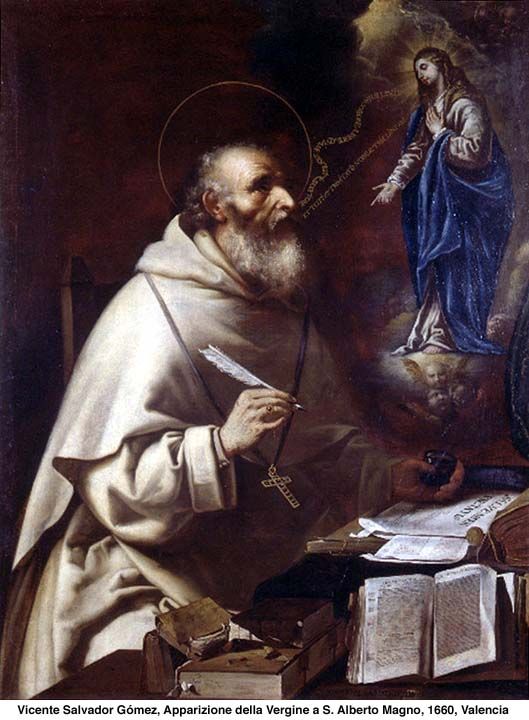
                               "Apparition of the Virgin to St. Albert the Great" by V. S. Gomez

Today the Church celebrates the feast of St. Albert the Great (d. 1280 AD).   The eldest son of a Bavarian count, Albert entered the Dominican order in about 1221, and was appointed provincial of the order in 1254.  Albert also served as bishop of  Regensburg for three years.   Though he discharged these duties with great care, most of St. Albert's efforts and energy were devoted to the study of philosophy and natural science.  St. Albert was an experimental scientist far in advance of his age, a philosopher through whom the works of Aristotle were transmitted to Europe, a naturalist, and a theologian.  St. Albert's compiled written works, on topics ranging from astronomy to zoology, fill thirty eight volumes.  In recognition of the staggering breadth of his knowledge, St. Albert is called "Doctor Universalis."  Notwithstanding the vast scope of his own intellectual achievement, St. Albert is best known as the teacher of St. Thomas Aquinas, whose brilliance he was quick to recognize.  He assisted St. Thomas in answering the errors of the Arabian philosopher Averroes, and was greatly grieved, for himself and for the Church, when St. Thomas died in 1274.  In his Divine Comedy, Dante places St. Albert and St. Thomas Aquinas together among the great lovers of wisdom in the Heaven of the Sun.

Here is a short sample of the thought of St. Albert:

“It is by the path of love, which is charity, that God draws near to man, and man to God. But where charity is not found, God cannot dwell. If, then, we possess charity, we possess God, for ‘God is Charity.’”


St. Albert the Great, pray for us.

Tuesday, November 8, 2011

"Eucharistic Representation, Application, and Immolation"


We continue our review of Abbot Vonier's highly instructive text "A Key to the Doctrine of the Eucharist."  Abbot Vonier follows St. Thomas Aquinas closely in describing what takes place sacramentally on the altar at Mass.

"As the Body and Blood on the altar are such a perfect representation of the broken Son of God on Calvary, they are also the most immediate and complete contact of the soul with all the saving power of Golgotha. . . . It would not be enough, in order to explain the total range of the Eucharistic sacrifice, to say that at the altar we offer up the Body and Blood of Christ; we do more, we immolate Christ, but - and here is an immense difference - not the Christ who is in heaven, because as such He is not represented on the altar at all, but the Christ of Calvary, as the Christ of Calvary is the only one who is represented on the altar."

St. Thomas Aquinas, pray for us.


Wednesday, November 2, 2011

"Whether the body of Christ be in this sacrament in very truth,

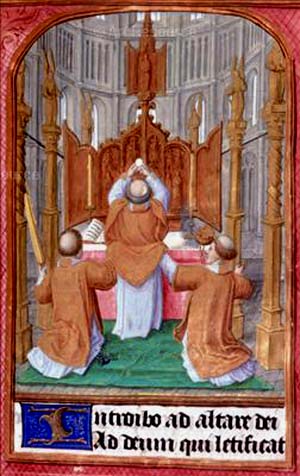
                              Is liturgy of this type partly to blame for confusion about Eucharist?


Or merely as in a figure or sign?"

According to a recent poll, Catholics appear to be more confused than ever about the Eucharist (among other Church teachings.)   We respond to this manifest ignorance by periodically transmitting the teaching of St. Thomas of Aquinas concerning the Eucharist.

To the above quaestio, St. Thomas answers: 

"The presence of Christ's true body and blood in this sacrament cannot be detected by sense, nor understanding, but by faith alone, which rests upon Divine authority. Hence, on Luke 22:19: "This is My body which shall be delivered up for you," Cyril says: "Doubt not whether this be true; but take rather the Saviour's words with faith; for since He is the Truth, He lieth not."'

For St. Thomas's full response (courtesy of New Advent) , see here.


St. Thomas Aquinas, pray for us.

Thursday, October 27, 2011

"Whether the matter of this sacrament is bread and wine?"


We respond to the manifest ignorance amongst Catholics regarding the Eucharist by periodically transmitting the teaching of St. Thomas concerning this sacrament.

To the above quaestio, St. Thomas answers:


"Christ instituted this sacrament under the species of bread and wine, as is evident from Matthew 26. Consequently, bread and wine are the proper matter of this sacrament. And the reasonableness of this is seen first, in the use of this sacrament, which is eating: for, as water is used in the sacrament of Baptism for the purpose of spiritual cleansing, since bodily cleansing is commonly done with water; so bread and wine, wherewith men are commonly fed, are employed in this sacrament for the use of spiritual eating."

Courtesy of New Advent, St. Thomas' complete answer here.

St. Thomas Aquinas, pray for us.