Showing posts with label Pope St. Gregory the Great. Show all posts

Wednesday, September 3, 2014

Hail, Gregory, Pope and traditional composer of an extremely old yet popular song


 "Pope Gregory dictating Gregorian Chant,"


Today is the feast of Pope St. Gregory the Great (circa 540 -604 AD), who sent St. Augustine of Canterbury to evangelize England, and is also credited with standardizing the mainstream form of Western plainchant, which is named "Gregorian Chant" in his honor.  Tradition also credits St. Gregory with composing Dies Irae, a Latin hymn used for centuries in the Requiem Mass.  According to Peter the Deacon, Gregory's disciple and friend, the inspiration for Dies Irae came to Gregory by way of a dove.  Indeed, Peter the Deacon claims that all of Gregory's writings were inspired in this way, which is why Gregory is usually depicted with a dove on his shoulder.

In the wake of Vatican II the funeral rite was revised, and Dies Irae was cut.  Cardinal Anibale Bugnini, a leading figure in the reform, explained why:

"They got rid of texts that smacked of a negative spirituality inherited from the Middle Ages. Thus they removed such familiar and even beloved texts as the "Libera Me, Domine", the "Dies Irae", and others that overemphasized judgment, fear, and despair.  These they replaced with texts urging Christian hope and arguably giving more effective expression to faith in the resurrection."


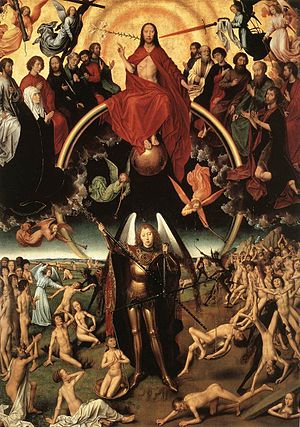
 "Last Judgment," Hans Memling c 1467 AD

Judgment is undeniably a fearful thing, though in my view ignoring it altogether is mighty unwise.

The Dies Irae tune is not just very old; it's also very popular.  It's been quoted in many classical works, and it's a favorite of movie score composers.  CBC host Tom Allen has much more here:


Monday, May 12, 2014

For the first time anywhere, "Name that chapel" and "Whose galero is that?" combined into a single game

St. Augustine of Canterbury meets King Aethelbert 
(partly obscured by galero which is very slowly turning to dust)

Today is the feast of St. Pancras, an early Roman martyr.  As mentioned in an earlier post today, Pope St. Gregory the Great bestowed relics of St. Pancras upon St. Augustine of Canterbury before ordering St. Augustine to England to evangelize the Anglo-Saxons.   St. Augustine duly carried the relics to England, where his efforts at evangelization met with great success, some of which may undoubtedly be attributed to the intercession of St. Pancras.   The first church St. Augustine consecrated in England was dedicated to St. Pancras, and it thrived for nearly a thousand years, before being dissolved and almost completely destroyed by King Henry VIII.

The mosaic above may be found in St. Augustine's chapel in Westminster Cathedral and depicts St. Augustine of Canterbury and his party of monks meeting King Aethelbert.  The galero very slowly turning to dust belonged to Cardinal Hume.

Hail, St. Pancras, first of the Ice Saints (or second, if you count St. Mamertus)

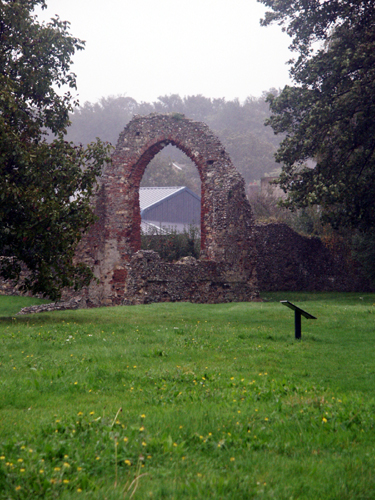
St. Pancras Church, Canterbury, England
Probably built by Roman Christians, then taken over by pagans, 
then re-consecrated by St. Augustine of Canterbury, then dissolved by King Henry VIII

St. Pancras was martyred in the persecution of Valerian (257 AD- 258) or in the persecution of Diocletian (304 AD - 306).  Pancras's Latin name is Pancratius, which means a box for holding everything.   St. Pancras's body was entombed in a catacomb on the Aurelian Way in Rome, and in the fourth century a church dedicated to St. Pancras was built above the catacomb.  In 597 AD, Pope St. Gregory the Great presented St. Augustine of Canterbury with relics of St. Pancras, and then sent him to England to evangelize the pagan Anglo-Saxons.   Aethelbert, the Anglo-Saxon king, was married to a Frankish (and Christian) queen, named Bertha, so it is perhaps not surprising that Aethelbert himself soon converted.   The conversion of the king meant the conversion of all his subjects, so this was quite a coup for St. Augustine.   


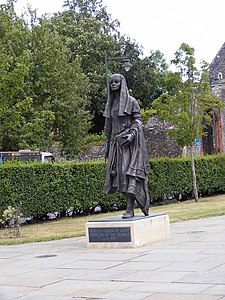
In his pagan days, Aethelbert had worshipped in his own pagan temple while Queen Bertha worshipped in her chapel.  After his conversion, Aethelbert didn't need his pagan temple anymore, since he and Bertha could now worship together.  So Aethelbert gave his old temple to St. Augustine, who consecrated it as a church in honor of St. Pancras.  Before long, a monastery was added to St. Pancras, which became the burial place of Kentish kings.  St. Pancras also became known as a seat of learning, with a very large library, as well as a place of pilgrimage, housing the preserved body of St. Mildred, which was reputed to work miracles.  Nearly a thousand years after its establishment, King Henry VIII dissolved the monastery, whereupon its library and even its stones were plundered, and the entire grounds sank into bleak disorder, from which they have recently begun to be rescued.   This statue of Queen Bertha has been erected on the former monastery grounds as part of a program to beautify them. 

Bertha, Queen of the Anglo-Saxons
  
The beautification program obviously still has a long way to go.

In many parts of Europe, St. Mamertus, St. Pancras and St. Servatius are known as the Ice Saints because their feast days (May 11, May 12, and May 13) generally coincide with a spell of chilly weather.  Some countries (Southern Germany, Austria, Northern Italy, Czech Republic) do not consider St. Mamertus an Ice Saint, so in these countries St. Pancras is the first Ice Saint.  


Friday, February 10, 2012

Hail, Scholastica, Abbess and Virgin

St. Scholastica


Today is the feast of St. Scholastica (ca. 480 AD - 547 AD), the twin sister of St. Benedict, the father of Western Monasticism.  St. Scholastica was abbess of a community of nuns near St. Benedict's monastery at Monte Cassino.  Each year, the saintly twins would spend a single day together.  One of the few sources for information regarding St. Scholastica is St. Gregory the Great's "Dialogues," wherein St. Gregory relates the following story concerning an annual visit of the twin saints:


"…Scholastica, was dedicated from her infancy to our Lord. Once a year she came to visit her brother. The man of God went to her not far from the gate of his monastery, at a place that belonged to the Abbey. It was there he would entertain her. Once upon a time she came to visit according to her custom, and her venerable brother with his monks went there to meet her.

They spent the whole day in the praises of God and spiritual talk, and when it was almost night, they dined together. As they were yet sitting at the table, talking of devout matters, it began to get dark. The holy Nun, his sister, entreated him to stay there all night that they might spend it in discoursing of the joys of heaven. By no persuasion, however, would he agree to that, saying that he might not by any means stay all night outside of his Abbey.

At that time, the sky was so clear that no cloud was to be seen. The Nun, hearing this denial of her brother, joined her hands together, laid them on the table, bowed her head on her hands, and prayed to almighty God.

Lifting her head from the table, there fell suddenly such a tempest of lightning and thundering, and such abundance of rain, that neither venerable Benedict, nor his monks that were with him, could put their heads out of doors. The holy Nun, having rested her head on her hands, poured forth such a flood of tears on the table, that she transformed the clear air to a watery sky.

After the end of her devotions, that storm of rain followed; her prayer and the rain so met together, that as she lifted up her head from the table, the thunder began.  So it was that in one and the very same instant that she lifted up her head, she brought down the rain.

The man of God, seeing that he could not, in the midst of such thunder and lightning and great abundance of rain return to his Abbey, began to be heavy and to complain to his sister, saying: "God forgive you, what have you done?" She answered him, "I desired you to stay, and you would not hear me; I have desired it of our good Lord, and he has granted my petition. Therefore if you can now depart, in God's name return to your monastery, and leave me here alone."

But the good father, not being able to leave, tarried there against his will where before he would not have stayed willingly. By that means, they watched all night and with spiritual and heavenly talk mutually comforted one another."

St. Scholastica and her twin brother St. Benedict were buried in a single tomb at Monte Cassino.


St. Scholastica, pray for us.


Tuesday, December 6, 2011

Advice for Advent

                                              Carmelite Sisters chanting the Salve Regina

From the Carmelite Sisters' December newsletter (to subscribe click here):


"St. Gregory [the Great] . . . counsels on how to prepare for the coming of the Great Day of the Lord: "Reflect with all your mind upon this day, my dearest Brethren.  Remedy what is now defective in your present life. Amend your ways. Conquer evil temptations by standing firm against them.  Repent with tears of the sins you have committed.  For the more you make ready against the severity of His justice by serving Him in love and fear, the more serenely shall you behold the Coming of that Eternal Judge."

Our Lady of Mount Carmel, pray for us.

Thursday, November 3, 2011

"Didn't Vatican II say we don't have to believe in Purgatory?"

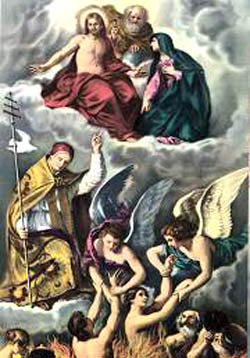
"St. Gregory the Great saving the Souls in Purgatory,"  Sebastiano Ricci

Short answer: no.  Carl Olson provides a longer answer here

Purgatory is an ancient doctrine.  Pope St. Gregory the Great (d. 604 AD) taught the following concerning Purgatory in his "Dialogues:"

As for certain lesser faults, we must believe that, before the Final Judgment, there is a purifying fire. He who is truth says that whoever utters blasphemy against the Holy Spirit will be pardoned neither in this age nor in the age to come. From this sentence we understand that certain offenses can be forgiven in this age, but certain others in the age to come.

There is a traditional practice begun by St. Gregory the Great of offering Mass for thirty consecutive days for the intention of a particular soul in the belief that doing so will release the soul from Purgatory.  More on the tradition of "the Gregorian Thirty" here.


Pope St. Gregory, pray for us.