September is the month the Church dedicates to contemplation of the Seven Dolors (or Sorrows) of Our Lady.
The second Dolor of Our Lady is the Flight into Egypt. Over the centuries, many artists have depicted this episode. Here is a sampling of the finer efforts:
 Gislebertus, Cathedral at Autun, France
The tympanum of Autun Cathedral (ca. 1120 AD) is inscribed "Gislebertus hoc fecit" ("Gilbert made this"). It is not known whether Gislebertus was the patron who underwrote the tympanum, or the principal sculptor of the statues which decorate it. If Gislebertus was indeed the sculptor, he was the first in medieval Europe to sign his work. In any event, the Autun style of sculpture, with its expressive, graceful elongated figures, was very influential and imitated in many places. The Autun statues also include an "Eve," the first large scale nude sculpture in Europe since Roman times.
 Chartres Cathedral (12th and 13th centuries)
In its long history, Chartres Cathedral has been spared major damage, though it has had several close calls. For instance, during the French Revolution the Revolutionary Committee voted to blow up the Cathedral, but the architect in charge of the project argued that the rubble thereby created would take years to remove, and the plan was dropped. However, the Cathedral did suffer the loss of its lead roof, which was removed to make bullets. Before the outbreak of WWII, the Cathedral's stained glass was removed for safekeeping. In 1944, the Cathedral itself was nearly destroyed by the US Army, which believed the structure had been occupied by elements of the German Army. A two man reconnaissance team led by Col. Welborn Barton Griffin, Jr. revealed that the Cathedral was free of German troops, and the order to bombard the cathedral was rescinded. In August, 1944, Col Griffin was killed in action.
 Giotto, Scrovegni Chapel (also called the Arena Chapel), Padua
The Scrovegni family derived its fortune from usury, which the Church condemned. Indeed, Dante placed Reginaldo degli Scrovegni in the seventh circle of Hell. It is believed the Scrovegni family built the beautiful Arena Chapel, decorated with Giotto frescoes depicting scenes from the life Our Lord and consecrated in 1305 AD, as penance for these sins.
 Fra Angelico
Fra Angelico (1395 AD - 1455 AD) , a Dominican friar, was beatified in 1982.
 "Rest on the Flight to Egypt," by Murillo
Though the Rest on the Flight to Egypt is not mentioned in the Gospels, from the fifteenth century onward paintings of this subject became popular. These paintings often included aprocryphal miracles such as the Christ child ordering a fig tree to bend down and provide fruit to St. Joseph, or ordering a spring to gush forth to provide water for his parents. The Council of Trent banned depiction of these dubious, non-scriptural miracles, and Murillo does not include them.

Our Lady of Sorrows, pray for us.
The second Dolor of Our Lady is the Flight into Egypt. Over the centuries, many artists have depicted this episode. Here is a sampling of the finer efforts:

The tympanum of Autun Cathedral (ca. 1120 AD) is inscribed "Gislebertus hoc fecit" ("Gilbert made this"). It is not known whether Gislebertus was the patron who underwrote the tympanum, or the principal sculptor of the statues which decorate it. If Gislebertus was indeed the sculptor, he was the first in medieval Europe to sign his work. In any event, the Autun style of sculpture, with its expressive, graceful elongated figures, was very influential and imitated in many places. The Autun statues also include an "Eve," the first large scale nude sculpture in Europe since Roman times.

In its long history, Chartres Cathedral has been spared major damage, though it has had several close calls. For instance, during the French Revolution the Revolutionary Committee voted to blow up the Cathedral, but the architect in charge of the project argued that the rubble thereby created would take years to remove, and the plan was dropped. However, the Cathedral did suffer the loss of its lead roof, which was removed to make bullets. Before the outbreak of WWII, the Cathedral's stained glass was removed for safekeeping. In 1944, the Cathedral itself was nearly destroyed by the US Army, which believed the structure had been occupied by elements of the German Army. A two man reconnaissance team led by Col. Welborn Barton Griffin, Jr. revealed that the Cathedral was free of German troops, and the order to bombard the cathedral was rescinded. In August, 1944, Col Griffin was killed in action.
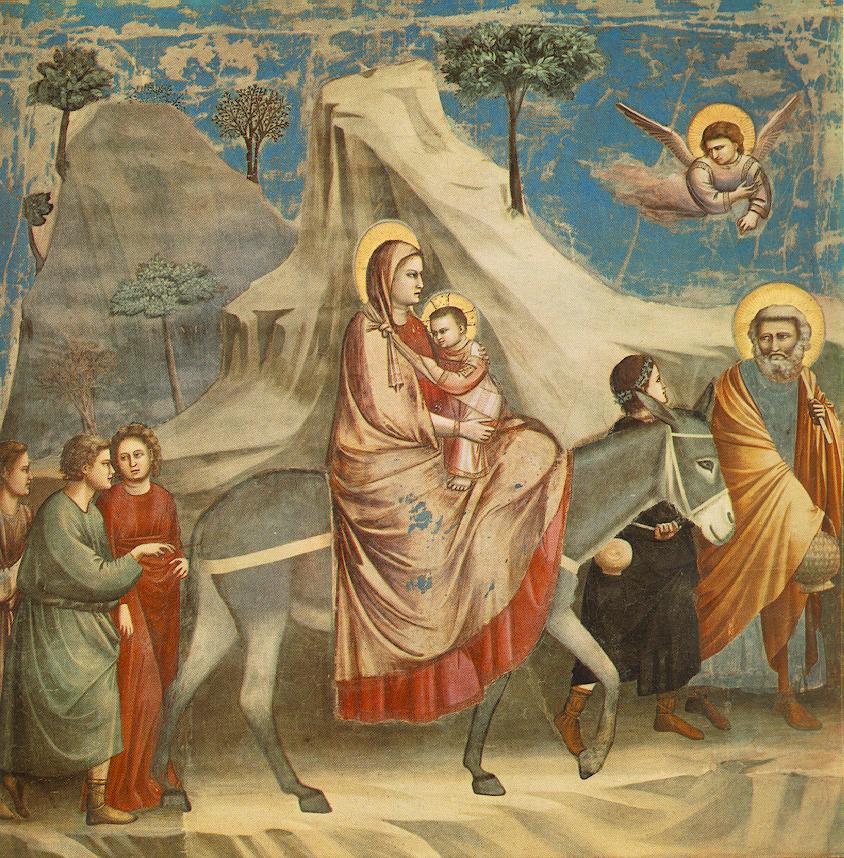
The Scrovegni family derived its fortune from usury, which the Church condemned. Indeed, Dante placed Reginaldo degli Scrovegni in the seventh circle of Hell. It is believed the Scrovegni family built the beautiful Arena Chapel, decorated with Giotto frescoes depicting scenes from the life Our Lord and consecrated in 1305 AD, as penance for these sins.

Fra Angelico (1395 AD - 1455 AD) , a Dominican friar, was beatified in 1982.

Though the Rest on the Flight to Egypt is not mentioned in the Gospels, from the fifteenth century onward paintings of this subject became popular. These paintings often included aprocryphal miracles such as the Christ child ordering a fig tree to bend down and provide fruit to St. Joseph, or ordering a spring to gush forth to provide water for his parents. The Council of Trent banned depiction of these dubious, non-scriptural miracles, and Murillo does not include them.

"Madonna of the Rocks" by Leonardo da Vinci
This depicts a legendary meeting en route to Egypt between the baby Jesus and St. John the Baptist, who was likewise fleeing the wrath of Herod.
Our Lady of Sorrows, pray for us.


