Monday, April 28, 2014

Unfortunately there are no questions about chapels


Blessed Duns Scotus, pray for us

In 2010, Pew Forum tested Americans' knowledge of religion.  Atheists got the highest grades, Catholics got the lowest.   Most Catholics even got the basic Catholic questions wrong.   You can take the Pew Forum test here.

A religion professor recently published a book on American religious illiteracy, and naturally, the professor has a quiz too, which you can take here.

Of course, you don't need to pass a multiple choice test to become a saint.  On the other hand, there's never been a saint so ignorant of the Faith that they couldn't name the seven sacraments, and didn't know what takes place at Mass.  Knowing those kinds of things has generally been considered the easy part about being Catholic.

If you are not a religious know it all but would like to become one, a good way to achieve this goal is by meandering through the Catholic Lifetime Reading Plan of the Servant of God, Fr. John Hardon, SJ.   A list of the works included in Fr. Hardon's Reading Plan is here.   There are a lot of books in the plan; Fr. Hardon allowed for unusually long lifespans. 

On her deathbed, St. Teresa of Avila, the great mystic and doctor of the Church, joyfully exclaimed again and again "I am a child of Holy Church, a child of Holy Church!"  It is indeed a great gift from God to be a child of Holy Church.  As St. Alphonsus Liguori notes, "He hath not done in like manner to every nation." (Ps. 147:20)  The reason for St. Teresa's joy can certainly be found in the books included in Fr. Hardon's reading plan.  Heck, St. Teresa wrote three of them herself.


Saturday, April 26, 2014

So why is it called a chapel anyway?

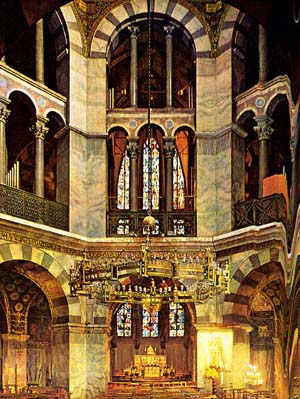
Charlemagne had a nice chapel

In the latest of a continuing series of posts beating the topic of chapels to death, today we look at why these funny little churches are called chapels in the first place.  Since we like quizzes around here, we'll give you four choices.  If you pick the right one you will be eligible for an official Inigo Hicks refrigerator magnet, to be distributed by Inigo Hicks himself at the next Inigo Hicks Fan Club Convention.

Choice #1: Chapels are small structures around the main altar of cathedrals, which are usually in the main cities ("capitula") of a district.

Choice #2: Chapels are small structures along the sides of a cathedral where travellers could pray without having to remove their riding britches ("chaparrals").

Choice #3: Chapels are small structures for sheltering the cloak ("capella") of St. Martin of Tours, the soldier-saint, which in olden times the Kings of France would carry into battle.

Choice #4: Chapels are small structures around the sides of a cathedral where the cathedral chapter ("capitulum"), a college of clerics which advises the bishop, meets.

Good luck.  By the way, "Why is it called a chapel?", like "Name that Chapel", is a no holds barred game without rules.   Feel free to consult google, dusty tomes of religious knowledge, and local religious know it alls.

Friday, April 25, 2014

More NY Catholic Trivia: Name that chapel

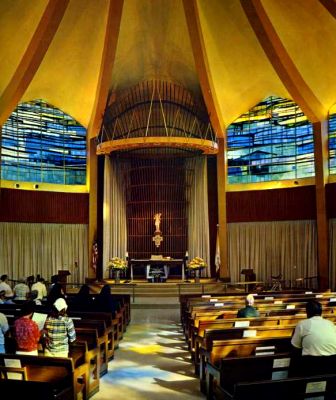
The 1955 chapel, which did not cost a million dollars
The 1966 chapel, which did cost a million dollars
 A wedding at the million dollar chapel

This chapel's construction was spearheaded by a US Customs employee seeking to honor a battlefield vow he'd made to the Virgin Mary.  The current chapel is actually the third built on the site in less than 50 years.   The first was built in 1955, but was soon demolished to permit airport expansion.  A second chapel was built in 1966, at a cost of more than a million dollars, which was a very large amount of money back then.   Willie Mays, the highest paid player in baseball that year, made $133,000.  The current highest paid baseball player makes $33 million.   If the cost of chapels has risen at the same rate as baseball salaries, a million dollar chapel, in 1966 dollars, would be the equivalent of a $225 million chapel today.

The chapel was heavily used; nine Masses were said in the chapel every weekend.   It's been observed that the acid test of a church's beauty is whether it's popular with brides.  If so, the million dollar chapel was certainly very beautiful, since droves of brides chose to be married there.  More than 100 weddings took place in the chapel every year, quite a large number considering the chapel wasn't associated with a parish, and its location was not especially convenient.  For most, getting to this chapel would entail beating the Van Wyck, which of course no one has ever done.

In 1988 the million dollar chapel, like its 1955 predecessor, was demolished to make way for airport expansion.  However, this time the budget for a new chapel was dramatically smaller than the amount available in 1966.  The new budget permitted only a closet-sized space within the airport terminal itself:  see the photo of the new chapel's dedication below.


I doubt the current chapel is popular with brides.

All three chapels shared the same name.   Name that chapel, and win an official Inigo Hicks refrigerator magnet.

Thursday, April 24, 2014

New York Catholic Trivia

This wasn't the main attraction

If you grew up in the NYC area during the early 1960s there's a good chance you visited this place.   More than 27 million people did, including Pope Paul VI.  On the busiest day, almost 184,000 people elbowed their way through.   Notable for its novelty rather than its beauty, this chapel was part of a larger building, but not a trace of it remains today.  Can you name it?  The usual refrigerator magnet will be awarded for each correct answer.

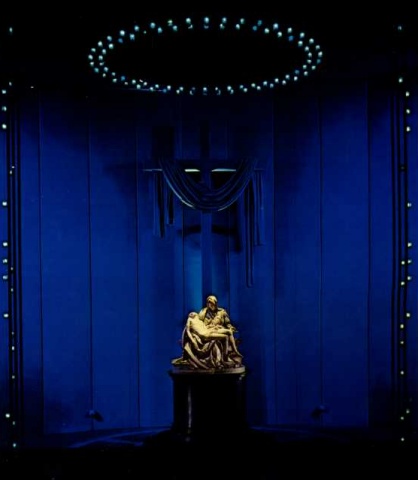
UPDATE:  We have winners!  It's the Good Shepherd Chapel of the Vatican Pavilion from the '64-'65 World's Fair.    The Vatican Pavilion's  big draw, and the crown jewel of the entire Fair, was this famous statue:

 
 Michelangelo's "Pieta" (1498 AD)
Visitors were moved past the statue along three motorized walkways.  Between the walkways and the Pieta was a wall of bullet proof glass; perhaps they feared Americans would be unable to resist pumping lead into such a pretty statue.  Notwithstanding the bullet proof glass, 27 million people gliding within yards of such a masterpiece evidently made the Vatican people very nervous, because afterwards they decided never to allow their treasures to be exhibited outside the Vatican again.  Little good it did the Pieta, as a madman would enter St. Peter's Basilica in 1972 and attack the statue with a hammer.  Applying a lesson learned in Queens, the Pieta has ever since been displayed behind bullet proof glass.

After the Fair, the Vatican Pavilion was demolished.  This engraved bench, with the oddly grandiose name of "Exedra," is the only reminder:


Wednesday, April 9, 2014

The country's in the very best of hands


 This eagle always reminds me of
this eagle


I couldn't resist stealing that header from the great professor, because it fits this story about the IRS, "where a worker at the tax agency’s customer help line urged taxpayers “to re-elect President Obama in 2012 by repeatedly reciting a chant based on the spelling of his last name,” the Office of Special Counsel said in a statement."

We can't get chant restored to the Mass, but over at the IRS they've got people chanting the president's name all day long.

It's almost like the IRS has become partisan and politicized, which is of course unpossible.

Thursday, March 20, 2014

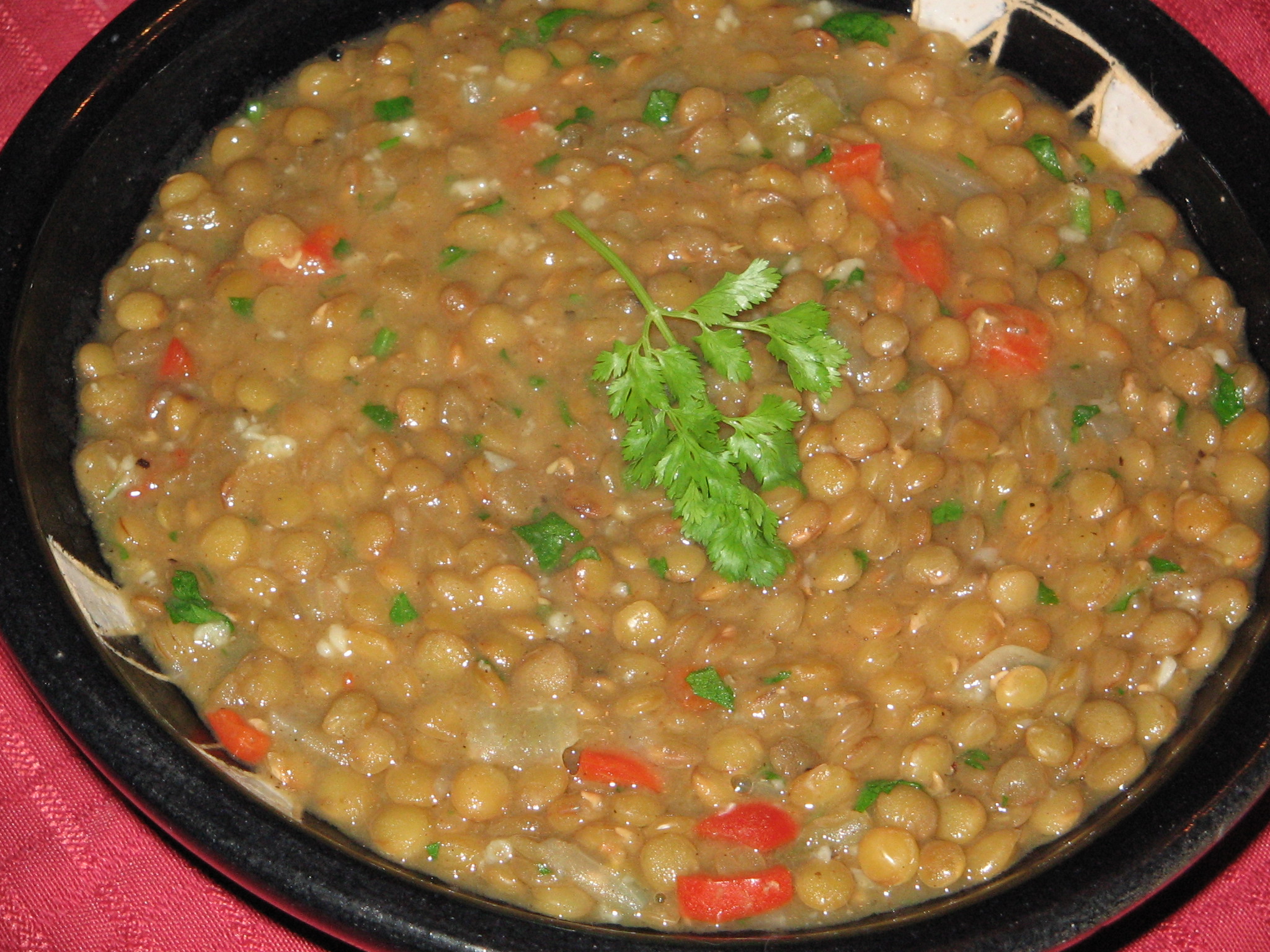
"In this lentil season..."


 The legume in question

"In this Lenten season," as mispronounced at Mass today.   Could be accurate description, for those keeping a strict fast.

Wednesday, March 19, 2014

Lenten Wisdom from St. Alphonsus Liguori

"Crucifixion," Basilica of San Clemente, Rome (approx 1123 AD)


St. Alphonsus Liguori (1696 AD - 1787 AD) was a lawyer who left that profession as a young man to become a priest.   St. Alphonsus would go on to found the Congregation of the Most Holy Redeemer, popularly known as the Redemptorists, and also was appointed bishop of an Italian diocese.   Eventually, St. Alphonsus was not only canonized but also declared a Doctor of the Church.

Although St. Alphonsus lived a very long life, the volume of his published works is still staggering.  His "Ascetical Works" alone comprise 24 volumes, each one close to 500 pages in length, and each one packed with citations from scripture and the saints.   St. Alphonsus' training in law clearly shows in these works, as each is a relentless exercise in persuasion.  St. Alphonsus employs every conceivable argument in support of his propositions, so that a reader sometimes feels worn out by his pleadings.  However, St. Alphonsus is not concerned whether, like the widow in the parable of the unjust judge, he succeeds partly or even mainly through persistence.    St. Alphonsus's only care is to convince us, through a thousand arguments, of a single point: that God's love for each of us is infinite.

Of St. Alphonsus's Ascetical Works, perhaps the volume best suited for Lent is "The Passion and Death of Jesus Christ."  The following is taken from the Introduction:

"'He who desires," says St. Bonaventure, " to go on advancing from virtue to virtue, from grace to grace, should meditate continually on the Passion of Jesus" . . . .

"St. Augustine also said that . . . . it was for this end that our Saviour suffered so much, in order that we should think of his sufferings; because if we think on them, it is impossible not to be inflamed with divine love."